
What Is Blockchain Data Engineering? A 2026 Primer

Vincent Charles
November 24, 2026 · 14 min read
What is blockchain data engineering?
Blockchain data engineering is building and running the pipelines that extract, decode, model, and serve onchain data so teams can use it. Engineers pull raw records from Ethereum, Solana and L2s, decode logs and traces, keep results correct through reorgs, and land tested models in a warehouse that analysts can query.
Chapter 1 of the blockchain data engineering guide puts it in one line: "The job is the mainstream data stack applied to chain data."
I am Vincent Charles, former data lead at Binance and Morpho. This primer explains how chain data differs from regular application data, how the pipeline fits together, what the 2026 stack looks like, and what jobs and pay look like right now.
Want the hands-on path? The blockchain data engineering guide covers this work in 14 chapters and 140 pages, with 23 hands-on labs, 3 portfolio projects, and private GitHub repo access. Get the guide.
TL;DR:
- The job is pipelines for onchain data. Blockchain data engineering extracts, decodes, models and serves what the chain recorded, so other teams can trust the numbers.
- Chain data is public but raw. Token amounts arrive without decimals, events are encoded against a contract ABI, and recent blocks can be replaced in a reorg.
- The pipeline has five stages. Data moves from nodes and RPC, to ingestion and indexers, to decoding and transforms, to a warehouse and SQL, then to dashboards and applications.
- Employers still ask for the mainstream stack. In a November 23, 2026 pull of Unchain Data's job board, 65 of 86 live data engineer roles name Python, 62 name SQL and 42 name Airflow.
- Pipelines show up more often than chain vocabulary. 66 of those 86 roles mention pipelines, but only 32 mention onchain data or blockchain data.
- The median posted pay is $196,285. That figure comes from the crypto data salaries page (November 2026 update, 37 verified data engineer ranges), with the middle half of postings from $166k to $220k.
How does blockchain data differ from regular data?
The source is the difference. A regular data engineer often starts from application databases, event streams or vendor APIs that already have named fields and types. A blockchain data engineer starts from what a chain actually records, which is public, incomplete until you decode it, and not shaped like a business table.
On Ethereum, Base and other EVM chains, that raw record is five datasets: blocks, transactions, receipts and logs, traces, and state. Logs do most of the analytics work, because contracts emit events for transfers, swaps, deposits and similar actions. Traces fill gaps that logs leave, such as native ETH moved by a contract. Solana records programs and accounts, and Sui records versioned objects, so the same question needs a different pipeline on each family of chains.
Three habits follow from that shape:
- Amounts are raw integers. On EVM chains, a token transfer comes in as a 256-bit integer. You have to apply the token's decimals before the number means what a dashboard should show.
- Events are encoded. A log is an address, topics and a data blob. You decode it against the contract ABI, and you have to be sure you are decoding the right contract.
- Recent history can change. Chains reorganize recent blocks. A pipeline that only inserts new rows will double count or drop events when a block is replaced. Production work means versioned writes, lookbacks and checks against the chain.
When those habits are missing, dashboards can still look finished and be wrong. See how to query blockchain data without bad metrics.
If you want the career path into this work, start with how to become a crypto data engineer.
How does a blockchain data engineering pipeline work?
Onchain data moves from nodes and RPC, to ingestion and indexers, to decoding and transforms, to a warehouse and SQL, then to dashboards and applications. That is the path the work follows, whether you build each stage yourself or buy part of it.
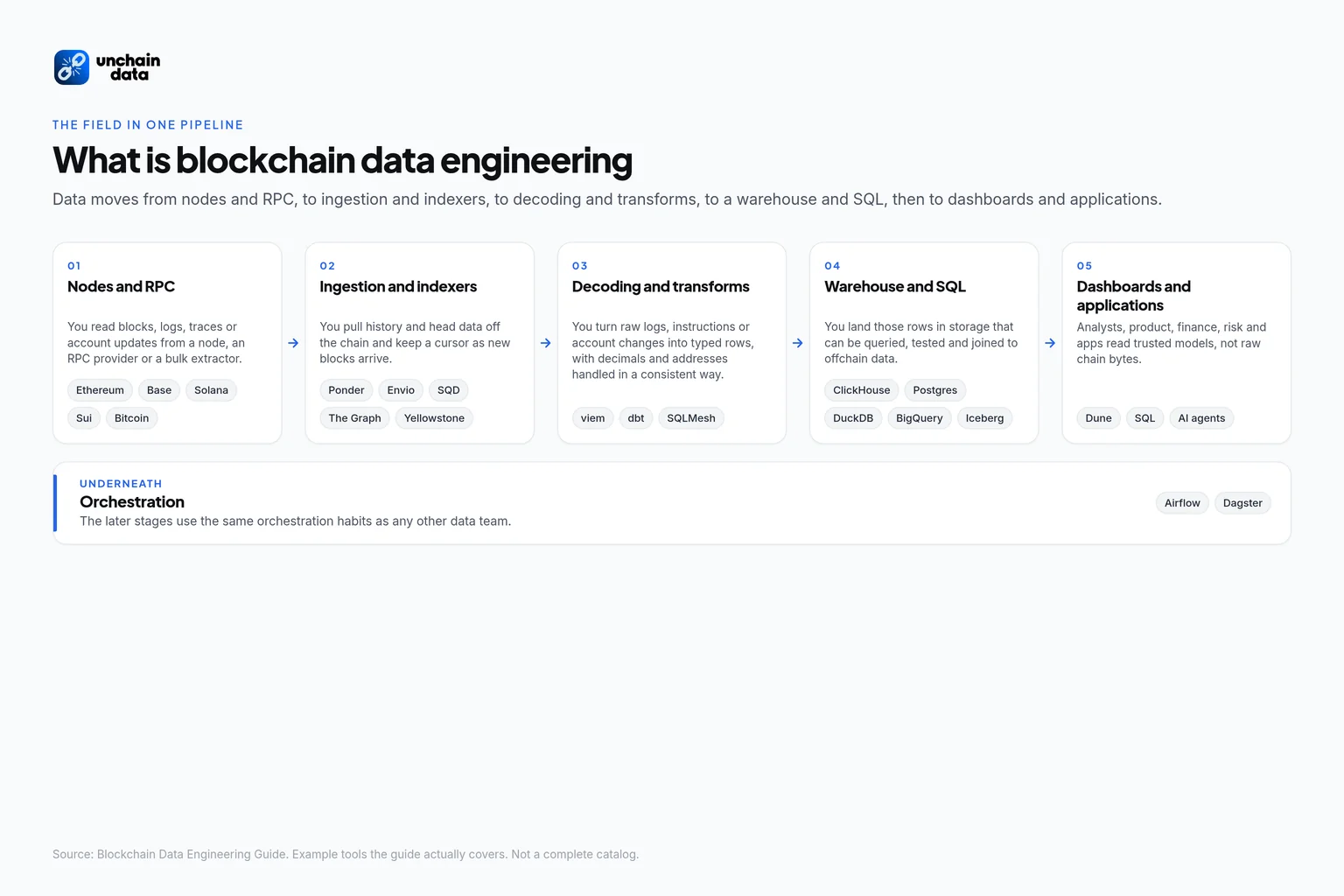
Orchestration runs underneath those five stages, with the same scheduling and operations habits as any other data team.
| Stage | What happens |
|---|---|
| Nodes and RPC | You read blocks, logs, traces or account updates from a node, an RPC provider or a bulk extractor. |
| Ingestion and indexers | You pull history and head data off the chain and keep a cursor as new blocks arrive. |
| Decoding and transforms | You turn raw logs, instructions or account changes into typed rows, with decimals and addresses handled in a consistent way. |
| Warehouse and SQL | You land those rows in storage that can be queried, tested and joined to offchain data. |
| Dashboards and applications | Analysts, product, finance, risk and apps read trusted models, not raw chain bytes. |
The hard part sits in the first three stages. A reorg, a missed log, a wrong ABI or a factory contract you did not index will flow downstream and look like a correct dashboard. The later stages use the same warehouse, modeling and orchestration habits as any other data team.
For a walkthrough that builds this path across chains, see the multi-chain data pipeline guide. For the tool choices at each layer, see blockchain data engineering tools.
What does the 2026 blockchain data engineering stack look like?
Most of the 2026 stack is the same as any data team: Python, SQL, an orchestrator, transforms and a warehouse. The onchain layer is smaller: RPC access, extractors, indexers, and storage that can handle reorgs and raw token amounts. Listings name the mainstream tools far more often than the chain-specific ones.
In the November 23, 2026 pull of Unchain Data's job board, the 86 live data engineer roles named these tools most often:
| Tool named in the listing | Live data engineer roles (of 86) |
|---|---|
| Python | 65 |
| SQL | 62 |
| Airflow | 42 |
| Spark | 40 |
| Kafka | 32 |
| dbt | 27 |
| Databricks | 23 |
| Snowflake | 19 |
| ClickHouse | 11 |
| Dune | 4 |
The pattern matches what the blockchain data engineering guide teaches. You still need Python, SQL, an orchestrator such as Airflow or Dagster, a transform layer such as dbt or SQLMesh, and a warehouse or an OLAP engine. For chain work, that base is joined by RPC access or a data node, extractors such as cryo, and indexing frameworks such as Ponder, Envio, SQD (formerly Subsquid), The Graph, Substreams, Goldsky, rindexer, or Yellowstone and Geyser for Solana. Storage that can handle reorgs and 256-bit amounts includes ClickHouse, DuckDB (and DuckLake), Postgres and Iceberg. The guide also covers Kafka, Redpanda and Flink for streaming, BigQuery, Snowflake, Databricks, Spark and Trino for warehouses and query engines, plus viem, Carbon, Helius, Dune and Allium.
Listings rarely name the onchain tools. Only 4 of the 86 roles mention indexing, and Dune appears in 4. Kafka appears in 32. The hiring signal is "can you run a production pipeline," not "have you used a particular indexer."
What does a blockchain data engineer do day to day?
A blockchain data engineer builds and runs the pipelines that turn chain data, and often product data, into tables a company can trust. Day to day, that means pulling raw data, decoding it, modeling and testing it, fixing breaks after a reorg or a contract upgrade, and serving numbers to analysts, dashboards, finance, risk and compliance.
Who hires you shapes the mix. On November 23, 2026, the companies with the most live data engineer roles on Unchain Data's job board were Coinbase (14), OKX (13) and Robinhood (9). At exchanges and fintechs, much of the data is offchain, in trading, payments and customer systems, with onchain data for deposits, withdrawals and compliance. At protocols and infrastructure companies, onchain data is closer to the core product.
This is also a senior-heavy market. 56 of the 86 live data engineer titles were senior, staff, lead, principal or head level, and only 3 were junior. The work assumes you can already ship a pipeline, then asks you to apply that skill to chain data. Browse the live crypto data engineer jobs to see what those teams are posting now.
How is blockchain data engineering different from analytics and from development?
Onchain analytics is querying and reading chain data in dashboards, notebooks or a SQL workspace. Blockchain data engineering builds and runs the pipelines, storage and models underneath. An analyst might write a query on a decoded transfers table. An engineer is responsible for that table being complete, correct after a reorg, and tested against the chain.
Protocol and smart contract engineering designs the chain and the contracts. A blockchain data engineer rarely writes those contracts, but does need to read ABIs, understand events and traces, and notice when a proxy or a factory changes what should be indexed. Development tools help you write, test and deploy contracts. Data tools help you extract and model what those contracts produce.
If you want analytics first, you can learn to query public tables. If you want this role, you need to get data into tables you control. For a closer comparison of the roles, see data analyst vs data engineer in crypto.
What skills do you need, and how do you learn them?
Start with solid SQL and some Python. Then learn how chain data is structured, how to index it, and how to store, model and orchestrate it. That order matches both the hiring data above and the path in the blockchain data engineering guide.
The practical skills are:
- Python and SQL. They are the common language of the job. 65 of 86 live data engineer roles name Python, and 62 name SQL.
- The onchain data model. Blocks, logs, traces, accounts and objects, plus decimals, ABIs and finality. This is the part that regular data engineering does not teach.
- Ingestion and indexing. RPC, extractors and indexing frameworks, with a plan for history, head and reorgs.
- Storage and modeling. Landing typed rows in ClickHouse, a warehouse or Postgres, then building tested models in dbt or SQLMesh.
- Orchestration and operations. Scheduling, watermarks, cost and failing loudly when the chain and the warehouse disagree.
The guide follows that path over 14 chapters and 7 appendices, in 140 pages, with 23 hands-on labs, 3 portfolio projects, and a private GitHub repo of runnable code. 19 of the labs run on free tools with no account. It comes in PDF, ePub and Markdown, so you can hand the Markdown file to your AI agent as context. Get the guide. For a step by step career plan around it, use how to become a crypto data engineer.
What does the job market and salary look like in 2026?
As of November 23, 2026, Unchain Data's job board listed 86 live data engineer roles at 37 crypto companies, out of 326 live roles at 108 companies. 56 of those 86 data engineer titles were senior, staff, lead, principal or head level.
Salary figures in this post come only from the crypto data salaries page, last updated November 2026. That salary sample is a different set from the live job counts above. For data engineers, the median of 37 verified employer-posted ranges is $196,285. The middle half of postings runs from $166k to $220k. The full range on that live page runs from $130k to $287k. For data analysts, the median of 30 verified ranges is $126,371. Each figure is the midpoint of a pay band the employer posted, not a negotiated offer.
Read those numbers as the middle of the posted market, not a target or a promise. For a closer look at how seniority and posted ranges break down, see blockchain data engineer salary. To see who is hiring today, browse crypto data engineer jobs.
Frequently Asked Questions
What is blockchain data engineering?
Blockchain data engineering is building and running the pipelines that extract, decode, model, and serve onchain data so teams can use it. Onchain analytics is querying and reading that data in dashboards. Protocol and smart contract engineering designs the chain and the contracts.
How does a blockchain data engineering pipeline work?
Onchain data moves from nodes and RPC, to ingestion and indexers, to decoding and transforms, to a warehouse and SQL, then to dashboards and applications. The first three stages are where reorgs, encoded logs and raw amounts have to be handled, or the warehouse will serve numbers that look finished and are still wrong.
How is blockchain data engineering different from onchain analytics?
Onchain analytics is about querying and reading chain data in dashboards or a SQL workspace. Blockchain data engineering builds the pipelines, storage and models underneath. You can learn to query public tables first, but this role is about producing tables other people can trust.
What tools do blockchain data engineers use?
The same core tools as other data engineers, plus a chain-specific layer. In the November 23, 2026 pull of Unchain Data's job board, 65 of 86 live data engineer roles named Python, 62 named SQL and 42 named Airflow. The chain layer adds RPC access, extractors such as cryo, and indexers such as Ponder, Envio, SQD or rindexer.
How do I become a blockchain data engineer?
Start with solid SQL and some Python. Then learn how chain data is structured, how to index it, and how to store, model and orchestrate it. Build one end to end project that starts from raw chain data and ends in a tested, queryable model. The blockchain data engineering guide follows that path, and how to become a crypto data engineer maps it to a hiring plan.
How much does a blockchain data engineer make?
The median of 37 verified employer-posted ranges on the crypto data salaries page is $196,285, as of the November 2026 update. The middle half of postings runs from $166k to $220k, and the full range on that live page runs from $130k to $287k. These are midpoints of posted pay bands, not negotiated compensation.
Is blockchain data engineering in demand in 2026?
Yes. On November 23, 2026, Unchain Data's job board listed 86 live data engineer roles at 37 companies. 66 of those roles mention pipelines, and the median posted pay on the salaries page is $196,285. Most of the titles are senior, so the demand is real, and so is the experience bar.
Key Takeaways
- Blockchain data engineering is pipeline work on chain data. The job is to extract, decode, model and serve what the chain recorded, not only to query a hosted table.
- The data is public, raw and occasionally rewritten. Decimals, ABIs and reorgs are the habits that separate this work from regular data engineering.
- The pipeline runs in five stages. Nodes and RPC, ingestion and indexers, decoding and transforms, warehouse and SQL, then dashboards and applications.
- Hiring still points at the mainstream stack. In the November 23, 2026 job board pull, Python, SQL, Airflow, Spark, Kafka and dbt lead the 86 live data engineer roles.
- 66 of 86 roles mention pipelines, but only 32 mention onchain or blockchain data. The edge is chain literacy on top of production data engineering.
- The median posted data engineer pay is $196,285. That figure is from the November 2026 crypto data salaries update, based on 37 verified data engineer ranges, versus a $126,371 median for analysts (30 ranges).
Related
Blockchain Data Engineer Salary 2026: What Verified Pay Ranges Show
How to Become a Crypto Data Engineer in 2026: Skills, Stack and a 6-Step Roadmap
Blockchain Data Engineering Tools: The 2026 Stack by Pipeline Layer
Multi-Chain Data Pipeline Guide for Web3 Teams
Best Web3 Data Engineer Jobs in 2026: What the Market Actually Wants
- Founder of Unchain Data
- Former data lead at Morpho Labs and Binance
- Builds Dune dashboards and data pipelines across Ethereum, Solana and Sui
- Advises VC funds and DeFi protocols on data strategy
- Featured on BBC for blockchain data research
Ready to practice what you just read?
WizardCamp has interactive SQL exercises on real blockchain data. Write queries, get instant feedback, earn certificates.
Explore WizardCamp