
How to Become a Crypto Data Engineer in 2026: Skills, Stack and a 6-Step Roadmap

Vincent Charles
November 4, 2026 · 12 min read
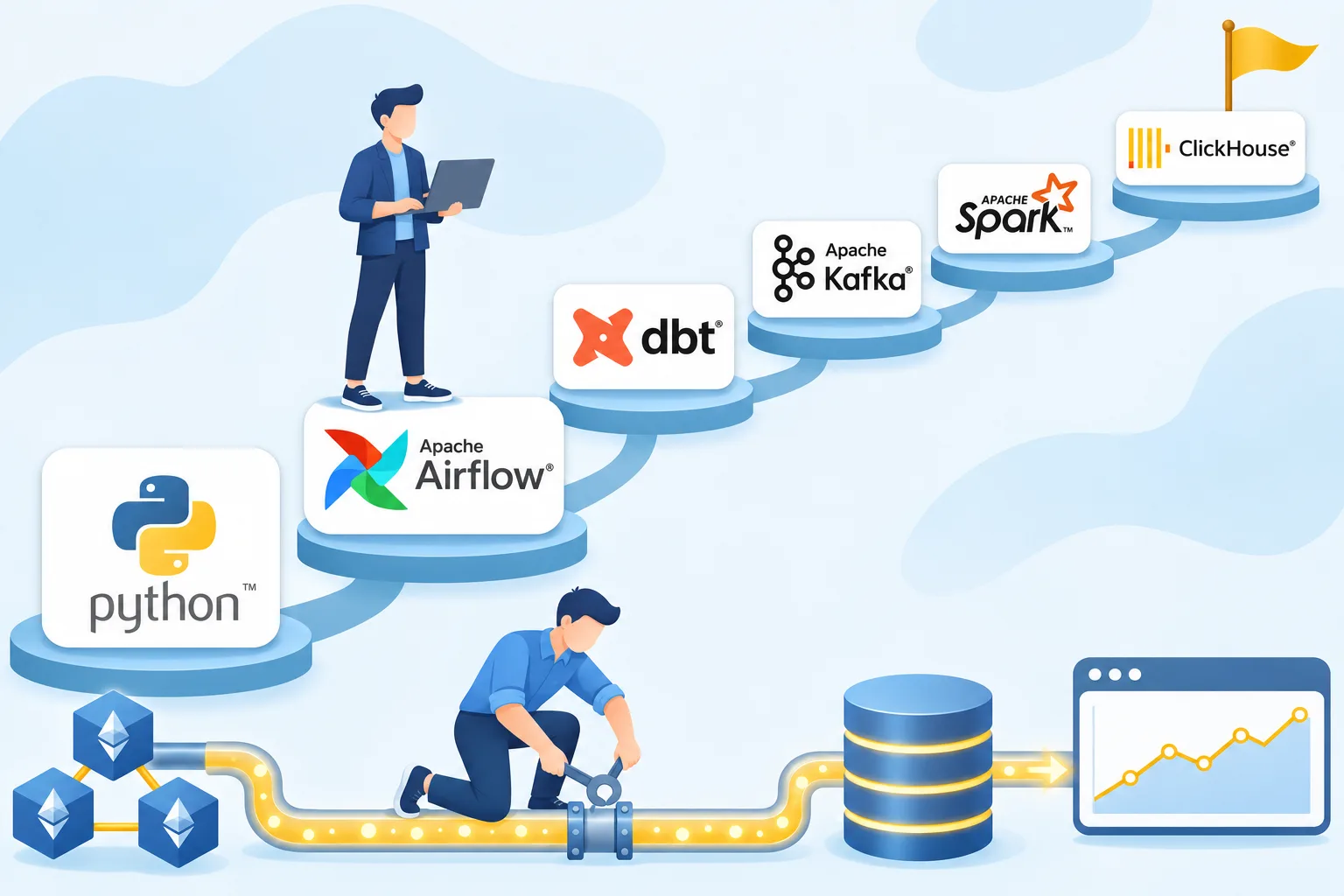
Most advice on how to become a crypto data engineer starts with blockchain theory and ends with a list of courses. The market hires the other way round. Companies want production data engineers first, and they pay a premium for the ones who also understand how blockchain data is shaped.
This roadmap is built on what employers actually post. As of October 30, 2026, Unchain Data's job board lists 90 live data engineer roles at 40 crypto companies, and I read what those listings ask for. I am Vincent Charles, former data lead at Binance and Morpho, and the six steps below are the path I would follow today. For the market context, see the crypto data salaries page and the live data engineer jobs.
Want the hands-on version? The Blockchain Data Engineering Guide turns this roadmap into exercises and end-to-end projects with runnable code.
TL;DR:
- Production skills come first. Python appears in 79% and SQL in 71% of 90 live crypto data engineer roles on Unchain Data's job board.
- Orchestration and transformation are next. Airflow shows up in 44% of listings, Spark in 42%, dbt in 34% and Kafka in 32%.
- Blockchain literacy is the edge. 29% of listings mention onchain data, so knowing logs, decimals and indexing sets you apart.
- Build one end-to-end project. Raw chain data into a tested, queryable model beats any certificate.
- The median is the middle of the market. Verified data engineer pay has a median of $196,285, with the middle half between $166k and $223k.
- Most roles want experience. 62% of live titles are senior, staff, lead or principal, and only 4% are junior.
What does a crypto data engineer do?
A crypto data engineer builds and runs the pipelines that move blockchain and product data into tables a company can trust. That covers pulling raw data from nodes or data providers, decoding it, modeling it, testing it, and serving it to analysts, dashboards, finance, risk and compliance teams.
The difference from a regular data engineering job is the source. Blockchain data is public but raw. Token amounts arrive without decimals applied, events are encoded against a contract's ABI, one user can control many wallets, and chains reorganize recent blocks. A crypto data engineer is the person who turns that into a model where a number means what the dashboard says it means.
Who hires them shapes the job. On Unchain Data's job board, the companies with the most live data engineer roles right now are Coinbase (15), OKX (10), Robinhood (9), Kraken (7), Binance (4) and Dune (4). At exchanges and fintechs, most of the data is offchain, in trading, payments and customer systems, with onchain data for deposits, withdrawals and compliance. At protocols and infrastructure companies, onchain data is the core product. For how this role differs from analysts and scientists, see data analyst vs data engineer vs data scientist in crypto.
What skills do crypto data engineer jobs ask for?
They ask for production data engineering, with blockchain knowledge on top. Here is how often each skill is mentioned across the 90 live data engineer listings on Unchain Data's job board (October 30, 2026):
| Skill named in the listing | Live roles | Share |
|---|---|---|
| Python | 71 | 79% |
| SQL | 64 | 71% |
| Airflow | 40 | 44% |
| Spark | 38 | 42% |
| dbt | 31 | 34% |
| Kafka | 29 | 32% |
| Onchain or on chain | 26 | 29% |
| Snowflake | 24 | 27% |
| Databricks | 24 | 27% |
| Flink | 21 | 23% |
| ClickHouse | 12 | 13% |
| Ethereum or EVM | 10 | 11% |
| Solana | 6 | 7% |
| Dune | 5 | 6% |
Two things stand out. First, the top of the table is the same stack any serious data team uses, so a strong data engineer from outside crypto already has most of what is asked. Second, crypto specific tools are rare in job descriptions. Employers expect blockchain knowledge to show in how you design a pipeline, not as a tool name on your resume. Our analysis of the best web3 data engineer jobs found the same pattern.
The roadmap: how to become a crypto data engineer in 6 steps
Step 1: Get production grade with Python and SQL
Python and SQL are the baseline in almost every listing. For SQL that means joins, CTEs, window functions, incremental logic and reading a query plan. For Python it means writing clean, tested code that calls APIs, handles retries and pagination, and loads data in batches.
A good readiness test: can you pull a paginated API, deduplicate it, and load it incrementally without double counting on rerun?
Step 2: Learn how blockchain data is shaped
This is the step that separates a crypto data engineer from a general one. Learn the raw objects and their traps:
- Blocks, transactions, logs and traces. Know what each contains, and why most protocol metrics come from event logs rather than transactions.
- Event decoding. Events are encoded against the contract's ABI. You need the ABI, the event signature, and the right contract address, including proxies.
- Token decimals. Raw amounts must be divided by the token's decimals before they mean anything. Forget it once and every volume chart is wrong.
- Wallets are not users. Bots, market makers, smart accounts and routers all sit behind addresses.
- Reorgs and finality. Recent blocks can change, so a pipeline that treats the chain tip as final will drift.
- EVM vs Solana. EVM chains are organized around contracts and logs. Solana is organized around accounts and program instructions, so the same question needs a different model.
If you want to practice reading this data with SQL first, our post on how to query blockchain data without bad metrics covers the definitions that most often go wrong.
Step 3: Learn ingestion and indexing
Next, learn where the data comes from and how it gets into your system. There are three common routes:
- Directly from nodes over RPC. Full control, but you own rate limits, retries, backfills and reorg handling.
- From an indexer or data provider. Faster to start, with decoded data, but you depend on their coverage and schema.
- From a public query platform such as Dune, mostly for exploration and validation rather than production pipelines.
Most teams mix them. Employers pay for knowing which route fits which question, and for the checks that catch a wrong source.
Step 4: Orchestrate, stream and model
This is where the stack in the table above comes in. Airflow (44% of listings) schedules and monitors batch jobs. Kafka (32%) and Flink (23%) handle streaming when data has to be fresh, for example for trading or risk. Spark (42%) and Databricks (27%) process large volumes. dbt (34%) turns raw tables into tested, documented models in a warehouse such as Snowflake (27%), or in ClickHouse (13%) when fast analytical queries on large event tables matter.
You do not need all of them. Pick one tool per layer, learn it well, and understand why a team would choose the alternative.
Step 5: Build one end-to-end project
One complete project beats a stack of certificates. A good portfolio project:
- Ingests raw data for one protocol on one chain, from RPC or a provider.
- Decodes the protocol's events from its ABI and applies token decimals.
- Loads it incrementally and handles reruns and recent reorgs.
- Models it with tests, for example daily deposits, unique depositors and fees.
- Reconciles the result against a figure the protocol publishes, and explains any gap.
The reconciliation step is what hiring managers remember. It shows you know a pipeline can run perfectly and still be wrong.
Step 6: Target the right employers and apply
Match your background to the employer type. If you come from backend or distributed systems, exchanges are often the strongest entry point because their data platforms run at large scale. If you come from analytics engineering, protocols and data infrastructure companies tend to value modeling and data quality most.
Expect most roles to be on site or hybrid. Of the 90 live listings on Unchain Data's job board, 50 (56%) are on site, 11 (12%) are hybrid and 15 (17%) are remote, with the rest unspecified. Browse the current crypto data engineer jobs to see who is hiring this week.
Can you become a crypto data engineer with no experience?
It is possible but hard, and the data says so. 56 of the 90 live data engineer titles on Unchain Data's job board (62%) include senior, staff, lead or principal, while only 4 (4%) include junior, entry, intern or graduate. Most crypto companies hire data engineers who can own a pipeline on day one.
The realistic routes in are:
- From data engineering outside crypto. The most common path. Your production skills transfer, and you add Step 2 and Step 3.
- From data analytics in crypto. Analysts who already know onchain data move into engineering by owning pipelines and models, often inside the same team.
- From backend engineering. Especially at exchanges, where data platform roles sit close to backend work.
If you are starting from zero, build the fundamentals first, then the project in Step 5. A public, tested, reconciled pipeline is the strongest signal you can send without the job title.
How much do crypto data engineers earn?
The verified median for crypto data engineers is $196,285, based on 35 verified salary ranges on the crypto data salaries page (August 2026 update). Read it as the middle of the market, not a target or a promise. The middle half of postings runs from about $166k to $223k, and the full range runs from about $130k to $287k.
Where a role lands depends on seniority, scope and location: engineers who own a platform end to end sit higher, narrower or earlier career roles lower. Pay disclosure is also limited: only 22 of the 90 live data engineer listings (24%) publish a verified salary range, so many offers are negotiated without a public benchmark. Each figure is the midpoint of a posted pay band, not actual negotiated compensation.
How is AI changing the role?
AI is now part of the job description. 37 of the 90 live data engineer listings on Unchain Data's job board (41%) mention machine learning, ML or LLMs. Some of these roles build data pipelines for models. Others expect engineers to use AI tools to write and review code faster.
My view: AI makes a strong crypto data engineer faster, but it does not replace the judgment in Step 2 and Step 5. An AI assistant will happily write a query that forgets token decimals or double counts a routed trade. The engineers who stand out use AI to move quickly and still verify every number against the chain.
Frequently Asked Questions
How long does it take to become a crypto data engineer?
It depends on your starting point. A data engineer from outside crypto mainly needs to learn blockchain data structures and ingestion, which is a much shorter path than starting from zero. Someone new to data engineering first needs production Python, SQL and orchestration skills, which takes longer.
Do I need to know Solidity to become a crypto data engineer?
No. You need to read contract events and ABIs, not write smart contracts. Only 2 of 90 live data engineer listings on Unchain Data's job board mention smart contracts, while 79% mention Python and 71% mention SQL.
What is the difference between a crypto data engineer and a blockchain developer?
A blockchain developer builds smart contracts and protocol software. A crypto data engineer builds the pipelines that collect, decode, model and serve blockchain and product data so teams can measure what happens onchain.
Is crypto data engineering a good career?
It is a specialized, well paid niche. The verified median salary for crypto data engineers is $196,285, as the middle of the market, and Unchain Data's job board lists 90 live data engineer roles at 40 companies today. Like any market, hiring moves with the crypto cycle, so strong fundamentals matter.
Which tools should I learn first?
Python and SQL, then one orchestration tool such as Airflow and one transformation tool such as dbt. Add Spark or Kafka if you target exchanges or streaming roles, and learn how to decode event logs from RPC or an indexer.
Key Takeaways
- Lead with production skills. Python (79%) and SQL (71%) are the baseline in live crypto data engineer listings.
- Add the core stack. Airflow, Spark, dbt and Kafka each appear in roughly a third or more of roles.
- Make blockchain literacy your edge. Event decoding, decimals, wallets versus users and reorgs separate a crypto data engineer from a general one.
- Prove it with one project. Ingest, decode, model, test and reconcile one protocol end to end.
- Plan for a senior market. 62% of live titles are senior or above, so build experience before you apply widely.
- Treat $196,285 as the midpoint. It is the middle of verified pay, not a target.
- Founder of Unchain Data
- Former data lead at Morpho Labs and Binance
- Builds Dune dashboards and data pipelines across Ethereum, Solana and Sui
- Advises VC funds and DeFi protocols on data strategy
- Featured on BBC for blockchain data research
Ready to practice what you just read?
WizardCamp has interactive SQL exercises on real blockchain data. Write queries, get instant feedback, earn certificates.
Explore WizardCamp