
Data Analyst vs Data Engineer vs Data Scientist in Crypto: What's Actually Different?

Vincent Charles
March 17, 2026 · 13 min read
Every Web3 job board lumps data roles into a single category. "Analyst" could mean a compliance specialist at Coinbase, a marketing analyst at Binance, or someone building Dune dashboards for a DeFi protocol. This lack of clarity costs job seekers time and costs hiring teams qualified applicants.
We analyzed 196 crypto data job listings across three core roles to answer the question directly: what do data analysts, data engineers, and data scientists actually do in Web3? What stacks do they use? What do they pay? And which path fits your background?
This breakdown uses real job data from the Unchain Data job aggregator, not recruiter surveys or self-reported estimates.
TL;DR: Across 196 crypto data jobs, data engineers earn the highest median salary at $135K, data scientists require Python in 92% of listings, and data analysts offer the most accessible entry point with 70% remote roles (Unchain Data Jobs, March 2026). Your best path depends on your background and whether you want the CEX corporate track or the onchain protocol track.
How Do the Three Core Crypto Data Roles Compare?
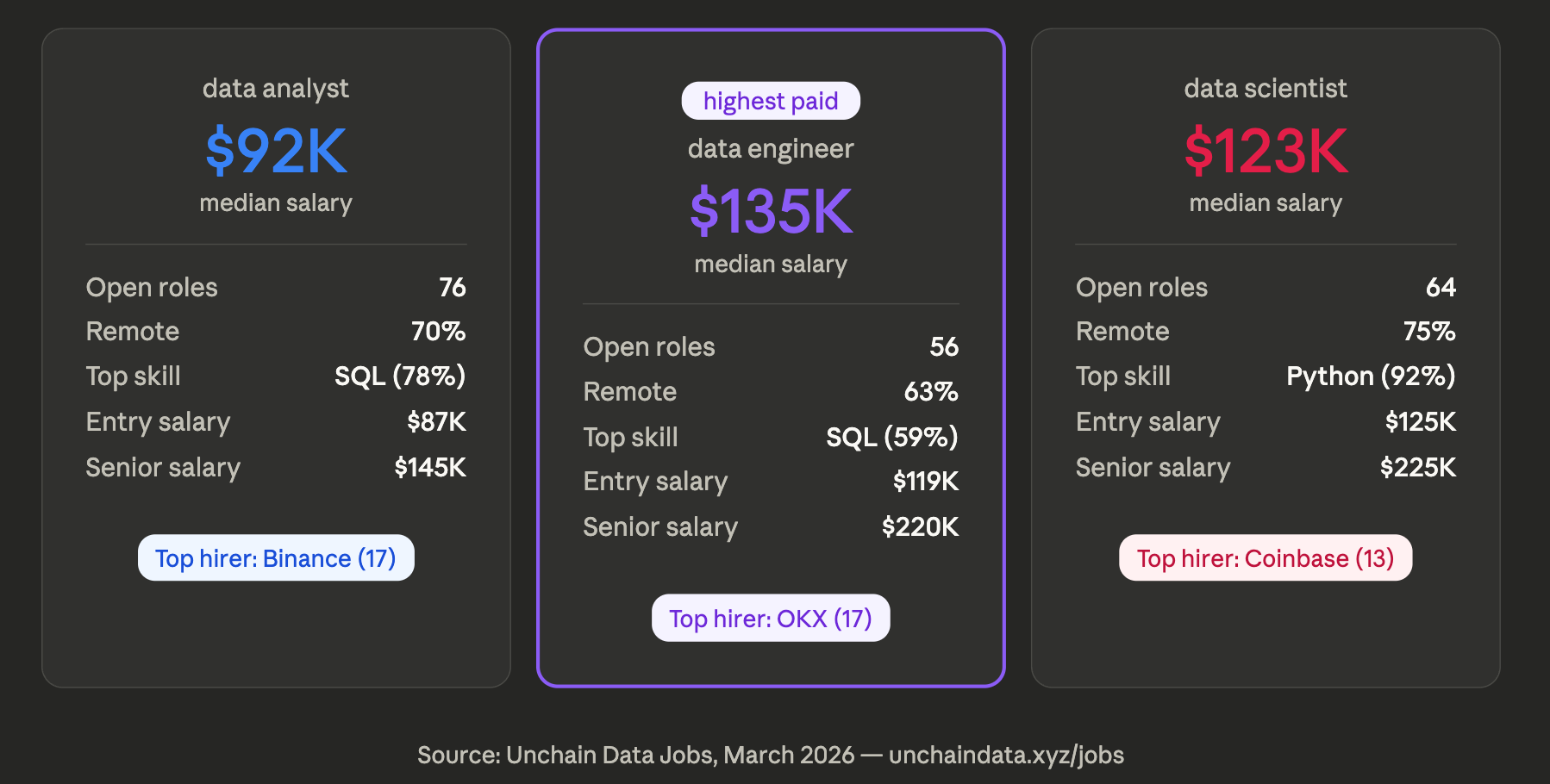
Data engineers command the highest median salary at $135K and the highest senior ceiling at $220K. Data scientists sit in between at $123K median, with seniors reaching $196K. Data analysts represent the largest pool with 76 open roles and the highest remote rate at 70% (Unchain Data Jobs, March 2026). The differences go far beyond pay.
Here is the full comparison based on our aggregated job data:
| Factor | Data Analyst | Data Engineer | Data Scientist |
|---|---|---|---|
| Open roles | 76 | 56 | 64 |
| Median salary | $92K | $135K | $123K |
| Salary range | $79K–$120K | $104K–$196K | $106K–$196K |
| Entry-level salary | $87K | $119K | $106K |
| Senior salary | $145K | $220K | $196K |
| Remote % | 70% | 63% | 75% |
| #1 skill | SQL (78%) | SQL (59%) | Python (92%) |
| #2 skill | Python (61%) | Python (54%) | SQL (48%) |
| #3 skill | Tableau (39%) | Spark (50%) | ML (33%) |
| Top hirer | Binance (17) | OKX (17) | Coinbase (13) |
Across all 196 roles, data engineers earn the highest median salary at $135K, 47% more than data analysts at $92K. Data scientists sit in between at $123K but show the strongest growth in AI-related skills, with LLMs appearing in 17% of listings. These numbers reflect what crypto companies are actually paying right now, not industry-wide averages diluted by non-blockchain employers.
Explore all 196+ crypto data jobs →
What Does a Crypto Data Analyst Actually Do?
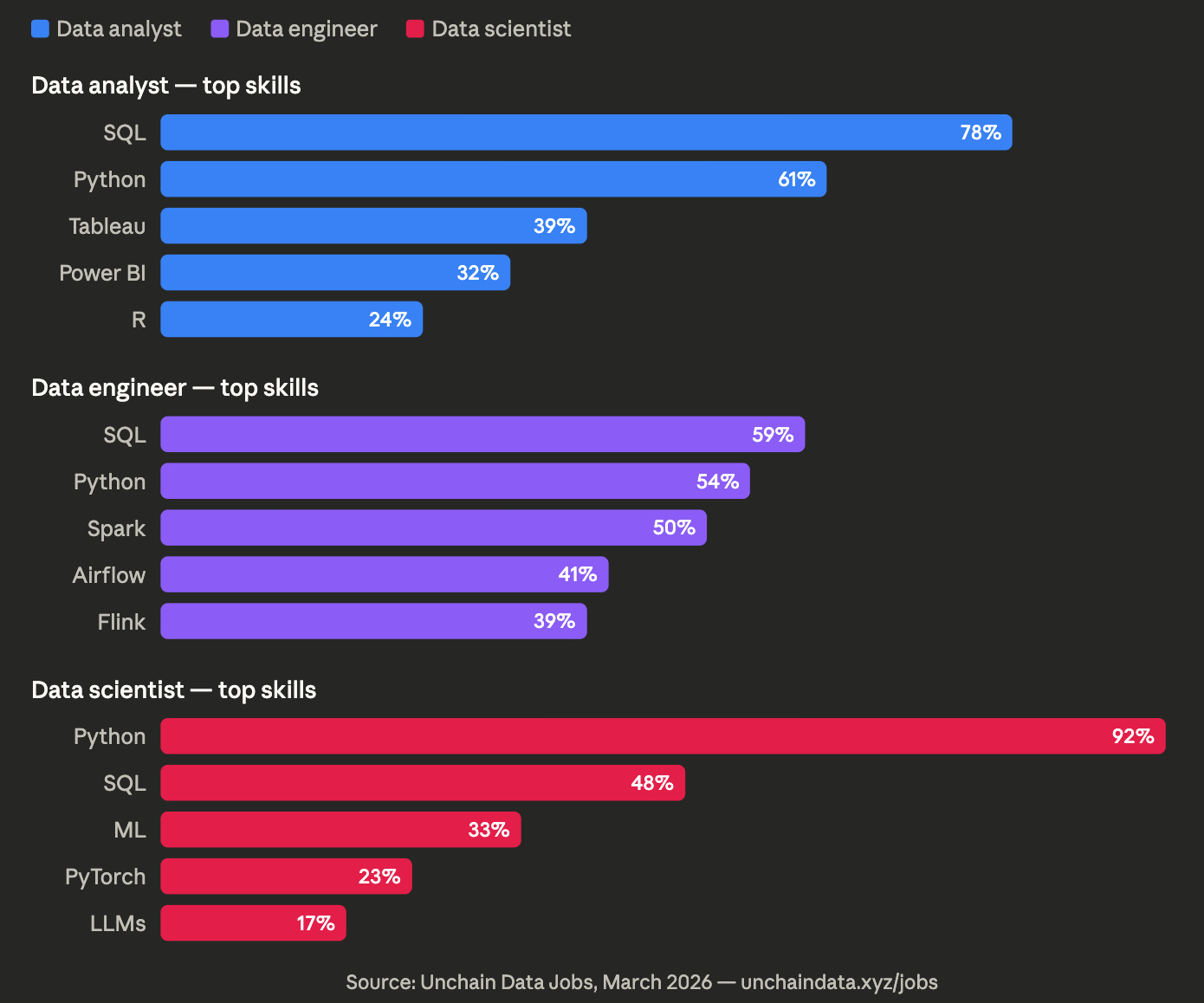
SQL appears in 78% of crypto data analyst job listings, making it the single most requested skill for the role. Python follows at 61%, then Tableau at 39% (Unchain Data Jobs, March 2026). But the real differentiator is not the tools. It is whether you can apply them to blockchain-specific problems.
A crypto data analyst transforms blockchain and market data into actionable insights. That means working with onchain analytics platforms like Dune and Nansen alongside traditional BI tools like Tableau and Power BI.
The day-to-day varies significantly by employer. At a centralized exchange like Binance or OKX, the work looks similar to a fintech analytics role: tracking KPIs, building dashboards, analyzing user behavior with SQL and Python. At a DeFi protocol, you might be analyzing wallet cohort behavior, measuring liquidity provider retention, or tracking governance participation.
The full stack breakdown for data analysts:
| Skill | % of Listings |
|---|---|
| SQL | 78% |
| Python | 61% |
| Tableau | 39% |
| Power BI | 32% |
| R | 24% |
| Excel | 22% |
| Looker | 17% |
| dbt | 8% |
| Mixpanel | 5% |
CEXs are the biggest hirers: Binance (17 open roles), OKX (13), and Kraken (7). They are also the most remote-friendly at 86% for analyst positions. DeFi protocols sit at just 33% remote.
Starting at a centralized exchange is likely the best entry point. CEXs are the largest recruiters and value experienced profiles from TradFi, Web2, ecommerce, and fintech with strong SQL and Python skills. For those more interested in decentralized protocols: start building a Dune dashboard portfolio, be active on X and LinkedIn, and get your name out there. Combining two in-demand specializations, like product analytics with onchain analytics, helps you stand out.
Median salary: $92K. Entry-level: $87K. Senior: $145K.
Browse 76 data analyst jobs with salary and stack data →
What Does a Crypto Data Engineer Do Differently?
Two-thirds of data engineering roles in crypto are at centralized exchanges, according to our job aggregator data. If you are coming from Web2, that is your entry point: Airflow, Spark, and dbt transfer directly, and CEXs value production-grade pipeline reliability over crypto-native credentials (Unchain Data Jobs, March 2026).
Data engineers build and maintain the data infrastructure that analysts and scientists depend on. In crypto, that means everything from traditional ETL pipelines to blockchain-specific challenges like onchain indexing, real-time transaction streaming, and cross-chain data aggregation.
The stack reflects this duality. Traditional tools dominate the rankings, but blockchain-specific skills separate the senior candidates:
| Skill | % of Listings |
|---|---|
| SQL | 59% |
| Python | 54% |
| Spark | 50% |
| Airflow | 41% |
| Flink | 39% |
| Kafka | 34% |
| Snowflake | 21% |
| Databricks | 21% |
| AWS | 20% |
| Java | 18% |
Spark appears in 50% of listings, the highest rate of any specialized tool across all three roles. Flink and Kafka at 39% and 34% reflect the industry's need for real-time data processing. Blockchain transactions happen continuously, and the ability to process them in near-real-time is a hard requirement for many teams.
Top hirers: OKX (17 open roles), Binance (8), Coinbase (7).
Data engineers earn the highest median salary of the three roles at $135K, with seniors reaching $220K. The salary range of $104K to $196K is also the widest, reflecting the gap between a junior pipeline engineer and a senior architect running a CEX's entire data infrastructure.
To stand out for protocol-side roles, get comfortable with RPC nodes, event log decoding, and onchain indexing tools like The Graph or Goldsky. Build one end-to-end project: raw chain data into a clean, queryable dashboard. That portfolio piece will outperform any certification.
Data engineers have the lowest remote rate of the three core roles at 63%.
Browse 56 data engineer jobs with salary and stack data →
What Makes a Crypto Data Scientist Different from Both?
Python appears in 92% of data scientist job listings in crypto, the highest single-skill concentration across all roles we track. SQL follows at just 48%, a sharp drop that reflects how the role skews toward modeling and experimentation rather than querying and reporting (Unchain Data Jobs, March 2026).
Data scientists in crypto apply statistical modeling and machine learning to blockchain data, token economics, and market behavior. The work spans risk models, user analytics, protocol optimization, and increasingly, LLM integration.
| Skill | % of Listings |
|---|---|
| Python | 92% |
| SQL | 48% |
| Machine Learning | 33% |
| PyTorch | 23% |
| LLMs | 17% |
| R | 13% |
| NLP | 11% |
| A/B Testing | 11% |
LLMs appearing in 17% of data scientist listings is a notable shift. A year ago, that number was close to zero. Companies like Coinbase and OKX are actively hiring for ML engineers who can integrate large language models into their data infrastructure.
CEXs hire nearly 60% of data scientists, but the most technically challenging problems live at protocols and market makers: liquidation risk modeling, incentive design, wallet-behavior clustering. Stablecoin issuers like Tether and research firms are nearly 100% remote.
Top hirers: Coinbase (13 open roles), Binance (10), Tether (9).
The edge that gets you hired: combine traditional ML rigor with genuine protocol knowledge. Understand how an AMM works, what a liquidation cascade looks like onchain, and why standard A/B testing assumptions break when wallets are correlated. Ship a public analysis on Dune or publish your methodology on Substack. A real model beats listing tools on a resume.
Median salary: $123K. Entry-level: $106K. Senior: $196K. Remote rate: 75%, the highest of the three core roles.
Browse 64 data scientist jobs with salary and stack data →
The CEX Track vs The Protocol Track: Two Career Paths Within Every Role
The distinction between data analyst, data engineer, and data scientist is only half the picture. Within each role, there is a second axis that shapes your daily work, your required skills, and your career trajectory: whether you work at a centralized exchange or a decentralized protocol.
The CEX track looks like a corporate data job at a large fintech company. SQL, Python, Tableau, Spark. Clear hierarchies. Established processes. Production-grade reliability is the priority. If you are coming from finance, e-commerce, or big tech analytics, the transition is straightforward. Our data shows CEXs offer the most roles, the highest remote rates (86% for analysts), and the most structured career paths.
The protocol track demands a fundamentally different skill set. You need to understand blockchain data structures, how an EVM chain stores state differently from Solana's account model, how to decode smart contract events, and how DeFi mechanisms like concentrated liquidity or lending protocols actually work at the data layer. The teams are smaller, more technical, and more mission-driven.
The jump between these two paths is harder than most people expect. The data structures are alien compared to a relational database. You are working with live transaction streams, decoding events, and building pipelines that most Web2 data engineers have never encountered.
Our job board is built around this distinction. You can filter by company type to see CEX roles or protocol roles separately, because the profiles are genuinely different.
Which Role Should You Start With?
The right entry point depends on where you are coming from. Here is a decision framework based on what we see in the hiring data:
Coming from TradFi, Web2 analytics, or e-commerce? Start as a data analyst at a CEX. Your SQL and Python skills transfer directly. This is the largest pool of roles (76 open positions) and the most accessible entry point. Binance and OKX are the biggest hirers.
Coming from backend engineering or data engineering? Go straight to data engineer at a CEX. Airflow, Spark, and dbt are the core stack, and these skills transfer from any industry. Once you are inside, learn onchain indexing to position yourself for protocol-side roles.
Coming from ML, statistics, or academic research? Data scientist. But differentiate yourself with protocol knowledge. CEXs hire the most (60% of roles), but understanding DeFi mechanics will set you apart for the roles where the most interesting problems live.
Want to skip the CEX path entirely? Build a public portfolio. Craft Dune dashboards. Publish analyses on Substack. Contribute to open-source data tooling. Protocol-side teams hire based on demonstrated onchain skill, not corporate resumes.
Explore hiring companies and their data stacks →
Frequently Asked Questions
What is the highest-paying crypto data role in 2026?
Data engineers earn the highest median at $135K, with seniors reaching $220K. Data scientists reach $196K at senior level with a $123K median. Data analysts start at $87K entry-level and reach $145K at senior level. All figures are based on 196 active crypto job listings tracked by Unchain Data in March 2026.
Do you need blockchain experience to get a crypto data job?
Not for most roles. CEXs hire the majority of data professionals across all three roles and actively recruit from TradFi, fintech, and e-commerce. Strong SQL and Python transfer directly. Blockchain-specific knowledge becomes a prerequisite for protocol-side positions, where understanding onchain data structures and DeFi mechanics is essential.
Are crypto data jobs remote?
Most are. Data scientists lead at 75% remote, followed by analysts at 70% and engineers at 63%. CEXs are the most remote-friendly employers, with 86% of their analyst roles available remotely. Stablecoin companies and research firms are nearly 100% remote. DeFi protocols are the least remote-friendly at 33% for analyst positions.
What tools should you learn for Web3 data jobs?
SQL and Python are required across all three roles, appearing in 48% to 92% of listings depending on the role. Beyond that, it splits: analysts need Tableau or Power BI (39%/32%), engineers need Spark and Airflow (50%/41%), and scientists need ML frameworks like PyTorch (23%). LLM skills are an emerging requirement in 17% of data scientist listings.
How is a crypto data job different from a regular data job?
The core skills are the same: SQL, Python, statistics, and analytical thinking. The difference is domain knowledge. Crypto data professionals need to understand blockchain data structures, DeFi protocol mechanics, wallet behavior patterns, and onchain analytics tools like Dune and Nansen. The learning curve from Web2 to protocol-side crypto data is significant, which is why CEXs serve as a common bridge.
View full salary breakdowns by experience level →
Key Takeaways
- Data analysts are the most accessible entry point: 76 roles, $92K median, 70% remote, SQL and Python transfer from any industry
- Data engineers earn the most: $135K median, $220K senior, but require the most specialized infrastructure skills
- Data scientists are the most Python-dependent (92%) and show the fastest growth in AI/LLM skills
- CEXs dominate hiring across all three roles and offer the easiest transition from Web2
- The CEX-to-protocol jump is a real career decision with different skill requirements, not just a company change
- Remote work is the norm: 63% to 75% across roles, with CEXs and stablecoin companies leading
The crypto data job market is growing but poorly organized. Understanding which role fits your background and which company track matches your ambitions is the first step.
All of the data in this article comes from our job aggregator, which tracks 196+ roles across data analysts, data engineers, data scientists, compliance analysts, and research positions. Every listing includes the actual tech stack, salary estimates, and company details.
- Founder of Unchain Data
- Former data lead at Morpho Labs and Binance
- Builds Dune dashboards and data pipelines across Ethereum, Solana and Sui
- Advises VC funds and DeFi protocols on data strategy
- Featured on BBC for blockchain data research
Ready to practice what you just read?
WizardCamp has interactive SQL exercises on real blockchain data. Write queries, get instant feedback, earn certificates.
Explore WizardCamp