
Blockchain Data Engineer Salary 2026: What Verified Pay Ranges Show

Vincent Charles
November 14, 2026 · 12 min read
Search for a blockchain data engineer salary and you get four different answers: a crypto engineer number, a global average for every data engineer in web3, a generic US data engineer figure, and a few job ads. None of them is the pay for the job you actually want, which is building pipelines on chain data at a crypto company.
This post uses employer-posted pay only. As of November 9, 2026, Unchain Data's job board lists 69 live data engineer roles at 31 crypto companies, and I read every salary range those employers published. I am Vincent Charles, former data lead at Binance and Morpho. For the full role by role picture, see the crypto data salaries page, and to see who is hiring right now, browse the live crypto data engineer jobs.
Want the skills behind those salaries? I wrote the Blockchain Data Engineering Guide. It comes in PDF, ePub and Markdown, plus a private GitHub repo of hands-on exercises and projects. It is updated monthly, every new edition is included, and you can hand the Markdown file to your AI agent as context. New to the role? Start with how to become a crypto data engineer.
TL;DR:
- The median is $196K ($196,285). That is the midpoint of employer-posted ranges for blockchain data engineers, based on 37 postings with a salary range on Unchain Data's job board (November 2026 update).
- The middle half of posted ranges runs about $166k to $220k. The median sits about $70K above the data analyst median.
- Seniority moves pay most. Across all crypto data roles in the guide's November 1, 2026 snapshot, the median midpoint is $196.3k for senior titles and $236.0k for staff or lead titles.
- Pay is rarely public. Only 18 of 69 live data engineer roles on Unchain Data's job board (26%) publish a verified salary range, and none of the 7 remote roles do.
- This is a senior market. 48 of 69 live titles (70%) are senior, staff, lead, principal or head level, and only 2 are junior.
How much does a blockchain data engineer make in 2026?
The median advertised salary for a blockchain data engineer is $196K ($196,285), based on 37 postings with a salary range on Unchain Data's job board (November 2026 update). The middle half of postings runs from about $166k to $220k. Each figure is the midpoint of a pay band the employer posted, so read it as the middle of the market, not as a target or a promise.
Data engineers also out-earn analysts in crypto. The median for crypto data analyst roles is $126K ($126,371, 30 postings), so the gap is about $70K. Both figures come from the crypto data salaries page, which counts verified ranges from live and closed postings and is refreshed quarterly. The guide's Chapter 1 has a dated snapshot of live postings only, taken on November 1, 2026, so its numbers differ slightly.
Why such a gap? In the guide's October 20, 2026 snapshot of Unchain Data's job board, data engineer roles usually own "pipelines, warehouses, streaming, onchain and offchain ingestion", while data analyst roles own "SQL, dashboards, product and business metrics". The guide also explains why the job title itself is hard to search for:
"The 'blockchain data engineer' or 'blockchain analytics engineer' this book trains you for is not a single job ad category. It is the overlap of the Data Engineer and Data Analyst families, plus the onchain skills that let you work with raw chain data instead of only curated tables. Most postings use neither phrase."
That is why this post reads pay from data engineer roles at crypto companies rather than from a title search. Like the guide, it uses only ranges posted by the employer, at each range's midpoint in USD. As the guide puts it: "Ranges show what employers advertise, not what anyone will earn."
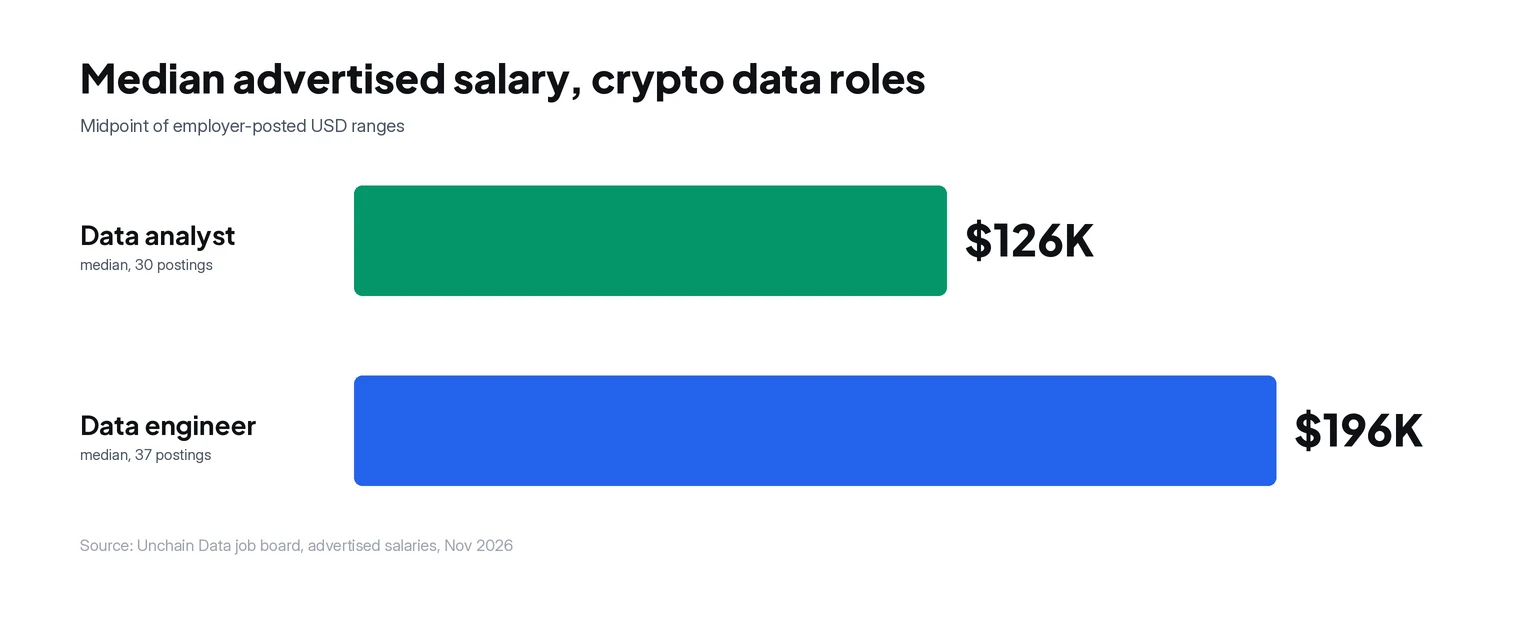
Median advertised salary on Unchain Data's job board, November 2026: $196K for data engineers (37 postings) versus $126K for data analysts (30 postings).
Blockchain data engineer salary by seniority
Seniority is the biggest driver of pay. The guide's analysis of employer-posted ranges puts the median midpoint at $165.9k for mid level or unspecified titles, $196.3k for senior titles and $236.0k for staff or lead titles. In the guide's words, "seniority moves pay about as much as role family." These seniority figures cover all crypto data roles in the guide's November 1, 2026 snapshot of live postings (mid or unspecified n = 27, senior n = 46, staff or lead n = 24), not data engineers only.
| Level in the title (all crypto data roles) | Median salary midpoint |
|---|---|
| Mid level or no level stated | $165.9k |
| Senior | $196.3k |
| Staff, principal or lead | $236.0k |
| Junior | Too few posted ranges to report |
Junior pay is the gap in every dataset I have seen. Of the 69 live data engineer roles on Unchain Data's job board as of November 9, 2026, only 2 have a junior or associate title, and neither publishes a salary range. If you are early in your career, the realistic route is usually a general data engineering role first, then a move into crypto with production experience.
Original data: what employers on our job board posted on November 9, 2026
This is a fresh pull from Unchain Data's job board on November 9, 2026, limited to live data engineer roles that publish a verified salary range in US dollars. It is a small sample, and I want to be upfront about that.
- Disclosure is low. 18 of 69 live data engineer roles (26%) publish a verified range. 17 are in US dollars and 1 is in pounds.
- Two employers dominate the sample. All 17 USD ranges come from Robinhood (9) and Coinbase (8). Treat the numbers below as what large exchanges and fintechs post, not the whole market.
- Typical posted band. The median posted minimum is $180,370 and the median posted maximum is $212,200. Bands are about $32,000 wide on average.
- Midpoints. The median midpoint is $196,285, the middle half runs from $165,853 to $213,000, and the full range runs from $148,000 to $287,000 (n = 17). That median happens to equal the salaries page figure, but this is a different, live only sample.
| Cut | Postings with a range | Median midpoint |
|---|---|---|
| Senior titles | 8 | $196,285 |
| Mid level or no level stated | 5 | $157,500 |
| Staff, principal or lead titles | 3 | $276,298 |
| United States | 14 | $199,384 |
| Canada | 3 | $157,500 |
| Hybrid | 9 | $194,500 |
| Onsite | 8 | $199,384 |
| Remote | 0 | No posted ranges |
Two patterns stand out. First, remote roles are the least transparent: none of the 7 live remote data engineer roles posts a verified range, so remote candidates negotiate with the least public information. Second, the jump from senior to staff or lead is large even in this small sample, which matches what the guide finds across the wider market.
What raises a blockchain data engineer's salary?
Employers pay for scope and for the skills that are hard to hire. In our analysis of 90 live data engineer listings for the crypto data engineer roadmap, Python and SQL were the baseline, while Kafka (32%), Flink (23%) and ClickHouse (13%) were much rarer, and only 29% mentioned onchain data at all. Skills that few candidates have tend to be where the negotiating room is.
- Own the platform, not a task. Staff and lead titles pay the most because they own ingestion, modeling and reliability end to end.
- Real time streaming. Exchanges and trading desks need fresh data for risk and markets, and streaming experience is scarcer than batch.
- Reorg safe, tested pipelines. Being able to show that your numbers reconcile with the chain is the clearest proof of seniority.
- Both EVM and Solana. The two chains model data differently, and few engineers are fluent in both.
The guide's Chapter 1 found the same pattern in its October 20, 2026 snapshot. Across 106 data engineer roles, the most requested tags were "Python 87, SQL 72, Airflow 43, Spark 39, dbt 35, Kafka 32, Snowflake 23, Databricks 21." Its note on the data: "Data Engineer roles name Kafka in 32 of 106 postings, so streaming is mainstream for crypto data engineers (Chapter 7). Head of Data roles name ClickHouse as often as Kafka, which reflects how many crypto companies run ClickHouse for chain-scale analytics (Chapter 8)."
The clearest proof of those skills is one project that ends in a check. Here is the guide's engineer track project from Chapter 14, lightly adapted:
- Index one protocol's events with Ponder, Envio or SQD (Chapter 5), or a Solana program with Carbon (Chapter 6).
- Store the data in Postgres or ClickHouse with natural keys and a watermark (Chapter 8).
- Add a reconciliation script that compares event totals with contract state at a finalized block (Chapter 11).
- Run it daily in CI or with an orchestrator, and fail the run on any difference.
As the guide says, "Hiring managers in crypto data look for evidence that you can get a number right, not just that you can produce one." The Blockchain Data Engineering Guide covers that whole stack across 14 chapters of hands-on exercises, so you can build the kind of project senior roles ask for.
How to negotiate a crypto data engineer offer
Start from data, and say how it was computed. The guide's tip: "When you quote salary data in an interview or a negotiation, say how it was computed." For example: "the median advertised salary for crypto data engineer roles is $196,285, from 37 postings with a salary range on Unchain Data's job board". That is far stronger than a number you saw online, and it signals the analytical habit employers are hiring for.
- Benchmark the level, not the title. Compare your offer with the band for the level you will actually work at, using the seniority table above.
- Ask for the posted range. Only about a quarter of roles publish one, so ask early, before you share a number.
- Separate base, bonus and tokens. A token grant can be worth a lot or nothing. Value the base on its own.
- Ask how remote pay is set. Some companies adjust pay by location, and remote roles on our board never publish a range.
Before you negotiate, be sure which job you are aiming for. The guide splits the work into three paths:
- Analyst. "You want to answer business questions with onchain data, build dashboards and explain metrics." About 7.5 to 8.5 hours of hands-on work.
- Analytics engineer. "You want to own trusted, tested data models that analysts and products build on." About 18.5 hours hands-on.
- Data engineer. "You want to build and run the pipelines: ingestion, indexing, streaming, storage and operations." Core chapters 2, 4, 5, 6, 7, 8, 9 and 12, about 22.5 to 23.5 hours hands-on.
Chapter 14's one pay fact is worth carrying into your plan: "seniority moves the median salary midpoint about as much as role family does; Staff or Lead titles sit about $70k above Mid or unspecified ones." On your resume, write each project as verb, tool, measurable result and check. The guide's example: "Built a TypeScript indexer for sUSDS into Postgres; reconciled 572k events to contract state with zero divergence; scheduled daily in GitHub Actions."
Frequently Asked Questions
What is the average blockchain data engineer salary?
The median blockchain data engineer salary is $196K ($196,285), based on 37 postings with a salary range on Unchain Data's job board (November 2026 update). That is the midpoint of employer-posted pay ranges, not negotiated or actual compensation.
Do blockchain data engineer jobs pay $200k?
At senior level and above, posted ranges reach that level. On Unchain Data's job board as of November 9, 2026, the median senior data engineer range has a midpoint of $196,285, and all 3 staff, principal or lead ranges have midpoints above $225,000.
How much does an entry level blockchain data engineer make?
There is not enough public data to give an honest number. Only 2 of 69 live data engineer roles on Unchain Data's job board have a junior title, and neither posts a salary range. Most people enter through a general data engineering role first.
Do remote blockchain data engineer jobs pay less?
We cannot tell from posted pay yet. None of the 7 live remote data engineer roles on Unchain Data's job board publishes a verified range, so ask every remote employer how they set pay by location.
Is a blockchain data engineer paid more than a crypto data analyst?
Yes. The median for crypto data analyst roles is $126K ($126,371, 30 postings), about $70K below data engineers. Check the crypto data salaries page for the latest figures. See the web3 data analyst salary post for the analyst side.
Key Takeaways
- Use the median as a midpoint. $196K ($196,285) is the middle of employer-posted pay, not a target.
- Seniority drives pay. Across all crypto data roles in the guide's November 1, 2026 snapshot, senior titles sit at $196.3k and staff or lead titles at $236.0k.
- Most pay is hidden. Only 26% of live data engineer roles on Unchain Data's job board post a verified range, and no remote role does.
- The market is senior. 70% of live titles are senior or above, and only 2 of 69 are junior.
- Scarce skills earn the premium. Streaming, reorg safe pipelines and fluency in both EVM and Solana are where negotiating room comes from.
- Build the proof. The blockchain data engineering guide gives you the projects to back up a senior ask.
- Founder of Unchain Data
- Former data lead at Morpho Labs and Binance
- Builds Dune dashboards and data pipelines across Ethereum, Solana and Sui
- Advises VC funds and DeFi protocols on data strategy
- Featured on BBC for blockchain data research
Ready to practice what you just read?
WizardCamp has interactive SQL exercises on real blockchain data. Write queries, get instant feedback, earn certificates.
Explore WizardCamp