
Blockchain Data Engineering Tools: The 2026 Stack by Pipeline Layer

Vincent Charles
November 18, 2026 · 22 min read
Most lists of blockchain data engineering tools are either generic data engineering roundups or crypto analytics dashboards. Neither tells you what a production onchain pipeline actually runs on, or which tools employers expect you to know. This post sorts the stack by pipeline layer and checks each layer against hiring data from Unchain Data's job board.
The starting point is a line from Chapter 1 of the blockchain data engineering guide: "The job is the mainstream data stack applied to chain data." Employers ask for Python, SQL, Spark, Airflow, dbt and a warehouse. Onchain tools are rarely named, but the work still starts on the chain.
The hiring figures that follow, unless a later date is given, come from the guide's October 20, 2026 snapshot of Unchain Data's job board: 489 live crypto data roles at 160 companies, including 106 data engineer roles. I am Vincent Charles, who worked on data at Binance and Morpho. For the market context, see the crypto data salaries page and the live crypto data engineer jobs.
Want the full stack with runnable code? The blockchain data engineering guide covers every layer below in 14 chapters, with hands-on projects, a private GitHub repo of runnable code, and monthly updates. It comes in PDF, ePub and Markdown, so you can hand the Markdown file to your AI agent as context. Every new edition is included. Get the guide.
TL;DR:
- The job is the mainstream stack plus an onchain layer. In the October 20, 2026 snapshot of Unchain Data's job board, Python appears in 356 of 489 live crypto data roles and SQL in 296. "Onchain" appears in 140 descriptions.
- Hiring managers ask for the pipeline and the warehouse. Spark is named in 104 roles, Airflow in 83, dbt in 78, Snowflake in 60 and Databricks in 46. Indexers are named in only 14, and Dune in 22.
- Data engineer listings follow the same pattern. Of 106 live data engineer roles, 87 name Python, 72 name SQL, 43 name Airflow, 39 name Spark, 35 name dbt and 32 name Kafka.
- Learn the stack in five layers. Index, Decode, Stream, Store and Model. Reorg handling is the real work at the first three.
- The pay gap is about $70K. The median advertised salary on Unchain Data's job board is $196K for data engineers versus $126K for analysts.
What are blockchain data engineering tools?
Blockchain data engineering tools are the software used to extract, decode, stream, store, model, schedule and serve onchain data. Some are built for blockchains, such as RPC access, chain extractors and indexing frameworks. Most are the same tools any modern data team runs, such as Kafka, ClickHouse, dbt and Airflow, used with patterns that handle chain specific problems like reorgs, encoded event logs and raw token amounts.
That split matters if you are coming from a regular data team. You probably already know half of this stack. The new part is getting data off the chain and decoding it, plus the habits that keep a chain pipeline correct. New to the role itself? Read how to become a crypto data engineer first.
Which tools do crypto data engineer jobs ask for?
Here is how often each tool is named across the 489 live crypto data roles on Unchain Data's job board in the guide's October 20, 2026 snapshot:
| Group | Tool named in the listing | Live roles (of 489) |
|---|---|---|
| Language | Python | 356 |
| Language | SQL | 296 |
| Processing | Spark | 104 |
| Orchestration | Airflow | 83 |
| Transformation | dbt | 78 |
| BI | Looker, Tableau or Metabase | 68 |
| Storage | Snowflake | 60 |
| Streaming | Kafka | 52 |
| Storage | Databricks | 46 |
| Streaming | Flink | 37 |
| Storage | BigQuery | 32 |
| Storage | ClickHouse | 29 |
| Storage | Postgres | 27 |
| Storage | Iceberg | 20 |
| Storage | Trino, Presto or Athena | 19 |
| Serving | Dune | 22 |
| Chain | "indexer" or "indexing" | 14 |
| Chain | The Graph or subgraph | 6 |
Among the 106 data engineer roles in that same snapshot, Python appears in 87, SQL in 72, Airflow in 43, Spark in 39, dbt in 35, Kafka in 32, Snowflake in 23 and Databricks in 21.
Two patterns stand out. First, the most requested tools are general purpose. As Chapter 5 of the guide puts it: "Hiring managers ask for the pipeline and the warehouse. The indexer is how you get there." Second, "onchain" appears in 140 of the 489 descriptions, while indexers are named in only 14 and The Graph or subgraphs in 6. The people who post these roles assume the blockchain part shows up in your design choices. Our analysis of the best web3 data engineer jobs found the same pattern from the job seeker side.
Employer mix matters for a learning plan. 204 of the 489 live roles are at centralized exchanges, so the exchange stack deserves more of your time than its share of crypto Twitter suggests.
The blockchain data engineering stack by pipeline layer
Every onchain pipeline answers the same five questions: how you get history and head data off the chain, how you make it readable, how you move it in real time, where it lives, and how you model it so people can trust it. Those five layers are Index, Decode, Stream, Store and Model. That is a reading path through the guide, not the guide's chapter titles.
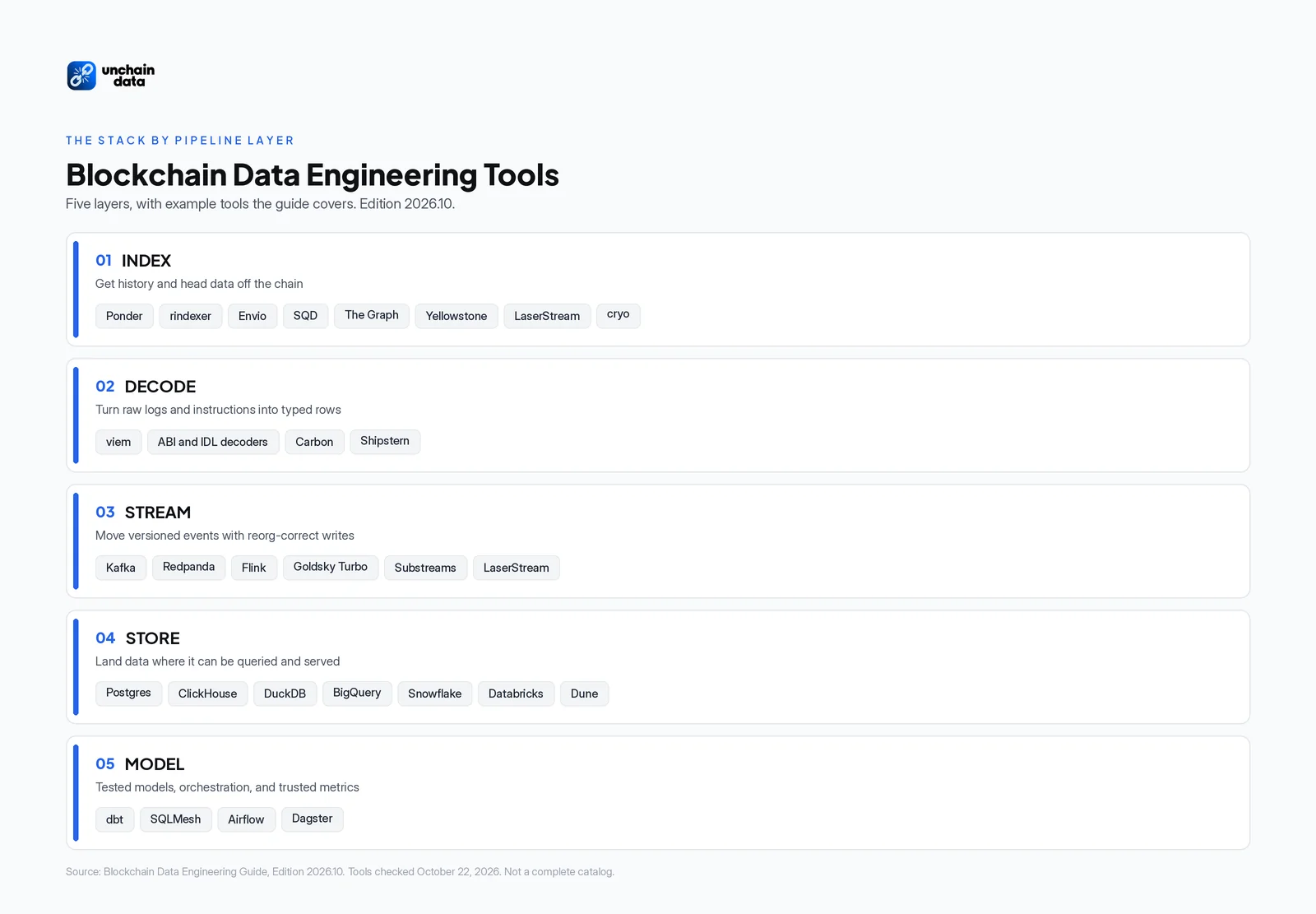
Five layers, with example tools the guide covers. Edition 2026.10, tools checked October 22, 2026.
1. Index: get history and head data off the chain
An indexer, as Chapter 5 of the guide puts it, "turns a chain's raw history into tables you can query." Every framework reads blocks, logs and traces, transforms them in your code or config, and writes them to a store that stays correct when the chain reorganizes.
Chapter 4 of the guide frames this as a choice of access path. In the author's experience, teams often combine two or three of these: Dune, the Coinbase CDP SQL API or BigQuery public data for one question now; cryo or HyperSync to Parquet, then DuckDB, for one-off history; an indexer framework for a continuous pipeline on specific contracts; a data node or Firehose into a warehouse for a whole chain; and eth_call or multicall at a block for point-in-time state, which needs an archive node. cryo is for analysis and one-off backfills. The guide is direct: "It is not a continuous pipeline: it has no reorg handling and no transformation step."
For EVM frameworks, Chapter 5 says to choose by data source and sink before you choose by features: Postgres for apps, ClickHouse or a warehouse for analytics. A common setup, in the author's experience, is two tools: one for app data, one for analytics.
- Ponder when you are a TypeScript team building a dApp backend or API and you want type safety end to end.
- Envio HyperIndex when backfill time dominates, or when you want one tool for EVM and Solana. As of October 22, 2026, its license allows self-hosting but is not open source in the OSI sense.
- SQD Pipes when your destination is an analytics store and you want reorg-safe writes without building them yourself. Pick Squid SDK when you need a GraphQL backend, and check licenses early (as of October 22, 2026, published package licenses have not always matched the repository).
- The Graph / subgraphs when a protocol already publishes one you can reuse, or when consumers expect a subgraph endpoint. For new analytics pipelines, the other indexers in this layer usually fit better. As of October 22, 2026, graph-node v0.42 (March 2026) removed Substreams support.
- rindexer or reth ExEx when your team writes Rust, you run your own nodes, or you need no-code indexing for standard events quickly.
- Goldsky Turbo when you want someone else to run the pipeline and you are fine with a proprietary service. As of October 2026, Turbo replaced Mirror for new work.
- Amp if your team already thinks in SQL and Parquet.
Across those options, the Chapter 5 takeaway is the same: "Reorg handling is the real work. Pick tools that do it for you, or model it explicitly in your sink."
Solana breaks most EVM habits. There are no logs to filter by default, a single swap fans out into a tree of inner instructions, and slot volume is much higher than Ethereum block volume. In the author's experience, most data teams start with a managed Yellowstone-compatible stream rather than running validator-class hardware.
| Situation | Choose |
|---|---|
| Real-time data for a few programs, you write TypeScript | A managed Yellowstone stream (LaserStream or similar) plus your own decoder, or Envio HyperIndex |
| You write Rust and need many DeFi programs decoded | Carbon or Shipstern on a managed stream |
| Analytics warehouse in TypeScript | SQD Pipes SDK into ClickHouse |
| You want no infrastructure | Substreams hosted sinks or Goldsky Turbo |
| History older than the replay window | RPC backfill, SQD Portal, HyperSync, or Dune and Allium tables |
As of October 2026, those managed streams expose Yellowstone gRPC, LaserStream replay is up to 48 hours (plan in hours, not slots), and Shipstern is the renamed Yellowstone Vixen. Every getTransaction and getBlock call must pass maxSupportedTransactionVersion: 1 since Solana v1 transactions went live on mainnet on September 15, 2026.
2. Decode: turn raw logs into typed rows
This layer is a skill, not a vendor category. Indexers decode for you, but you should be able to do it by hand first, because decoding is what turns RPC bytes into tables you can model.
Chapter 2 of the guide walks through decoding a log by hand. A log has the emitting contract, up to four 32-byte topics, and an unindexed data blob. For a normal event, topics[0] is the keccak-256 hash of the event signature. Count topics before you decode: an ERC-721 Transfer has four topics, an ERC-20 Transfer has three. Indexed dynamic types are stored as their keccak-256 hash, so the original value cannot be decoded from the log.
Chapter 5 tells you to write a short viem script before choosing a framework. It shows exactly what every framework automates for you: paging, decoding, retries, persistence and reorgs. Before you pick a tool, Chapter 3 says to write an indexing spec: contracts, proxy history, events, edge cases and golden transactions. A written indexing spec makes the choice of framework almost mechanical.
On Solana, decoding is based on instructions and IDLs. Carbon generates decoders from IDLs, and Shipstern is a program-aware parser. Token-2022 is a second token program. A pipeline that filters on the original program id silently drops those transfers (Chapter 6).
3. Stream: move versioned events with reorg-correct writes
Batch hourly pipelines were fine when dashboards refreshed daily. In 2026, teams want data in seconds, so this layer is the broker, the chain native stream, and the correctness rules.
In the October 20, 2026 snapshot, Kafka is mentioned in 52 of 489 live roles and Flink in 37. Among data engineer roles, 32 of 106 carry a Kafka tag. "The broker is the contract between teams. Producers write decoded, versioned events; consumers read at their own pace and can replay from an offset when they fix a bug."
- Apache Kafka is the default, with managed options on every cloud.
- Redpanda is Kafka-compatible, with simpler operations and a lighter footprint for local development. As of October 2026, the core license is Business Source License 1.1.
- Apache Flink handles windowed aggregations, joins across streams, and exactly-once state.
- ClickHouse Kafka engine plus materialized views when the only consumer is analytics.
Managed ingestion you do not have to build, as of October 2026, includes StreamingFast Substreams, Goldsky Turbo, QuickNode Streams, Allium Datastreams and Beam, and Helius LaserStream. Allium quotes roughly 3 to 5 seconds latency for Datastreams and under 2 seconds P50 for filtered Beam streams. Those are vendor figures, as of October 2026.
Four correctness rules from Chapter 7: key everything by chain position, (chain_id, block_number, log_index) on EVM and (slot, signature, outer_index, inner_index) on Solana; carry finality with the data (block_hash and a finality status); make reorgs explicit messages (tombstones or compensating events), and do not let a retracted block disappear at the boundary; and design for at-least-once delivery with idempotent writes. Managed streams remove most ingestion work. "Correctness at the boundary is still yours." Sub-second block times also make block counts useless as clocks. Use timestamps.
4. Store: land data where it can be queried and served
Once events are decoded, they need a home that can answer questions fast. For onchain data that usually means ClickHouse for chain-scale analytics, DuckDB for files on disk, or Postgres next to an indexer.
In the October 20, 2026 snapshot, ClickHouse is mentioned in 29 of 489 live roles and Postgres in 27. DuckDB is rarely named in postings, but it is the fastest way to build a portfolio project on Parquet files. The guide's rule is: "Choose storage by query shape: serving and exact math in Postgres, chain-scale scans in ClickHouse, file analytics in DuckDB."
Decide the uint256 policy before loading the first row. Never let a JavaScript number or a Python float touch a raw amount. Use NUMERIC(78,0) in Postgres and UInt256 in ClickHouse. BigQuery and Snowflake cannot hold every uint256, so store the raw value as a string. In ClickHouse, the table engine is your reorg policy, and materialized views never see replacements. For near-head data, use ReplacingMergeTree(version, is_deleted). Finalized-only loads can use plain MergeTree. A finalized-only Postgres indexer with a watermark and natural keys is simple, exact and enough for one protocol. Move off Postgres when full-table aggregations take minutes, when you pass a few hundred million rows, or when dashboards scan history on every load. Then keep Postgres for serving and replicate to ClickHouse or a warehouse for analytics.
Warehouses are named far more often than OLAP engines. "Most crypto data jobs at large employers run on Spark, Snowflake or Databricks, not on crypto-specific platforms." Iceberg v3 is now broadly supported, which makes an open lakehouse a realistic default for chain data. Partition by block date and cluster by contract, and give address lookups their own layout.
Chapter 9 of the guide maps a typical stack by company type:
| Company type | Typical stack |
|---|---|
| Early protocol team | Indexer to Postgres, Dune for public dashboards, DuckDB for ad-hoc work |
| Protocol foundation or ecosystem fund | Dune or Allium for coverage, a small warehouse (BigQuery or Snowflake) |
| Exchange (the largest employer group in the snapshot) | Kafka plus ClickHouse for real time, Snowflake or Databricks for finance and compliance, own nodes or vendor feeds |
| Compliance or analytics vendor | Lakehouse on Iceberg or Delta, Spark or Trino, own indexing |
| Trading firm or market maker | Low-latency streams into ClickHouse or in-house stores, Parquet archives |
Managed platforms are the other store decision. Unless onchain data is the product, indexing everything yourself rarely pays off. That is practitioner judgment from Chapter 10, and the takeaway is "Buy coverage, build specifics." Vendor tables cover common questions. Contract-specific logic and low latency usually need your own pipeline. "Always reconcile a vendor number against an independent computation before you publish it."
Dune is the platform named most often, in 22 of 489 live roles, followed by Nansen (6), Allium (4), Flipside (3), and Artemis and Goldsky (1 each). Treat platform names as a bonus on a resume, not the core. Checked October 22, 2026, Dune's free plan is a 14-day trial with Plus features and 2,500 credits, then the account becomes view-only.
5. Model: tested models, orchestration and trusted metrics
dbt is the transformation tool the market names, and the only SQL transformation framework among the 19 tools most often mentioned in the October 20, 2026 snapshot. SQLMesh is the comparison case in the guide (donated to the Linux Foundation in March 2026, Apache-2.0).
As of October 2026, dbt v2 (formerly Fusion) has been generally available since September 16, 2026. "dbt v2 is now the default dbt; dbt OSS and v1 remain Apache-2.0." The guide's examples were run on dbt Core 1.12.6, not on dbt v2. Dune's dbt connector is documented with the v1 dbt-trino adapter, so stay on v1 there until Dune documents v2 support.
Most onchain data teams, including Dune's Spellbook, layer data from raw to decoded, staging, curated, marts and metrics. Give every metric one definition. Incremental models must replace whole date ranges, with a lookback longer than the slowest chain's finality lag. A key-based merge leaves rows that a reorg removed. Reconciliation against the chain itself is the test that matters most in this field.
Chapter 12 of the guide is direct on orchestration: "Choose Airflow when the job market matters to you or your company already runs it. Choose Dagster when your work is mostly dbt models and tables, because its asset graph maps directly to them. Choose Prefect for small Python-heavy teams who want the least ceremony." Airflow appears in 83 of 489 live roles, and in 43 of 106 data engineer roles. As of October 2026, Airflow 3.3 added durable task state, which fits chain watermarks well, and Dagster's assets fit dbt-heavy work. Separate backfill from live tailing, and make every load idempotent on a natural key.
On serving, the guide's line still holds: "A public Dune dashboard is still the best proof of skill for a crypto data role," if it has a clear question, a methods panel, a reconciliation and clickable explorer links. Internal BI tools such as Looker, Tableau and Metabase connect to your warehouse. The work is in the semantic layer (one definition per metric) and in access control.
If you would rather have this built for your team, see our onchain pipelines service.
Which blockchain data engineering tools should you learn first?
Learn in the order the October 20, 2026 snapshot rewards, then add the chain specific layers:
- Python and SQL to production level. They lead both the 489-role snapshot and the 106 data engineer roles.
- Airflow plus dbt. Together they cover orchestration and transformation, and they are the two most named tools in those layers.
- Spark or Kafka. These are the processing and streaming tools the snapshot names most often.
- One warehouse and one OLAP engine. 204 of the 489 roles are at centralized exchanges, so Spark, Snowflake or Databricks deserve time. Learn ClickHouse for onchain scans and Postgres for serving.
- Ingestion and decoding. Write a short viem script or run an indexer against a real contract, decode its events, and handle a reorg.
That last step is what turns a strong data engineer into a blockchain data engineer. It is also what the market pays for. The blockchain data engineer salary post shows a $196K median advertised salary for data engineer roles versus $126K for analysts on Unchain Data's job board, a gap of about $70K.
Coming from a regular data team? You can reuse most of what you know. The blockchain data engineering guide walks through each layer with hands-on projects, including EVM and Solana indexing, ClickHouse with reorg-safe tables, Kafka and Redpanda streaming, dbt or SQLMesh, and Airflow or Dagster.
What a later board pull shows (November 16, 2026)
The figures above are the guide's October 20, 2026 snapshot. A later, narrower pull of Unchain Data's job board on November 16, 2026 listed 75 live data engineer roles at 34 crypto companies. That is a different sample, not an update of the 489-role snapshot, and the two should not be mixed.
| Pipeline layer | Tool named in the listing | Live data engineer roles (of 75) | Share |
|---|---|---|---|
| Language | Python | 61 | 81% |
| Language | SQL | 55 | 73% |
| Orchestration | Airflow | 37 | 49% |
| Orchestration | Dagster | 8 | 11% |
| Processing | Spark | 33 | 44% |
| Streaming | Kafka | 25 | 33% |
| Streaming | Flink | 20 | 27% |
| Transformation | dbt | 23 | 31% |
| Storage | Databricks | 22 | 29% |
| Storage | Snowflake | 19 | 25% |
| Storage | Iceberg, Delta Lake or Hudi | 12 | 16% |
| Storage | ClickHouse | 9 | 12% |
| Storage | BigQuery | 8 | 11% |
| Storage | Postgres | 8 | 11% |
| Serving | Tableau, Looker, Metabase, Superset or Power BI | 14 | 19% |
| Serving | Dune | 5 | 7% |
| Chain | Onchain or on chain | 23 | 31% |
| Chain | Ethereum or EVM | 9 | 12% |
| Chain | Solana | 6 | 8% |
| Ingestion | RPC or nodes | 3 | 4% |
The later pull still agrees with the October snapshot on the shape of demand. The most named tools are general purpose: Airflow, Spark, Kafka and dbt lead, and 20 of the 75 listings (27%) name both dbt and Airflow. Only 24 listings (32%) use any chain specific term at all. 61% of those 75 titles are senior, staff, lead or principal, so production experience counts.
Are there open source blockchain data engineering tools?
Yes, and you can build a complete pipeline on tools the guide covers. cryo handles one-off extracts. Ponder and rindexer cover indexing. Kafka and Flink cover streaming. ClickHouse, Postgres, DuckDB and Iceberg cover storage. dbt OSS, SQLMesh, Airflow and Dagster cover transformation and orchestration. Some widely used options are not open source in the OSI sense (Envio, as of October 22, 2026) or use a Business Source License (Redpanda core, as of October 2026). Check licenses early. Most of the paid options sit in two places: hosted RPC and managed warehouses or data platforms.
Frequently Asked Questions
What is blockchain data engineering?
Blockchain data engineering is building and running the pipelines that extract, decode, model and serve onchain data so teams can use it. Onchain analytics is querying and reading that data. Smart contract and protocol engineering designs the chain and the contracts.
What tools do blockchain data engineers use?
The same core tools as other data engineers, plus chain specific ones. In the October 20, 2026 snapshot of Unchain Data's job board, the most named tools across 489 live roles are Python, SQL, Spark, Airflow, dbt, Snowflake and Databricks. The chain specific layer adds RPC access or a data node, extractors such as cryo, and indexing frameworks such as Ponder, Envio, SQD, rindexer or a managed stream.
What is the difference between blockchain development tools and blockchain data tools?
Development tools help you write, test and deploy smart contracts. Data tools help you extract and model what those contracts produce onchain. A blockchain data engineer rarely writes Solidity, but needs to read ABIs and understand events and traces.
What are the best tools for blockchain data engineering in Python?
Python appears in 356 of 489 live roles in the October 20, 2026 snapshot, and in 87 of 106 data engineer roles. For chain work, a short viem script covers RPC access and decoding, Airflow and Dagster are Python native orchestrators, and dbt and SQLMesh handle the SQL modeling layer around it.
Do I need Dune to become a blockchain data engineer?
No. Dune is named in 22 of 489 live roles in the October 20, 2026 snapshot. It is useful for learning onchain data, validating numbers, and as a public proof of skill. Employers hire data engineers to build pipelines, not only to query a hosted platform. Treat platform names as a bonus on a resume, not the core.
Is blockchain data engineering still in demand in 2026?
Yes. The guide's October 20, 2026 snapshot of Unchain Data's job board listed 489 live crypto data roles at 160 companies, including 106 data engineer roles. A later pull on November 16, 2026 listed 75 live data engineer roles at 34 companies, and 61% of those titles were senior, staff, lead or principal. The median advertised salary for data engineers is $196K versus $126K for analysts.
Key Takeaways
- Most of the stack is standard. In the October 20, 2026 snapshot of Unchain Data's job board, Python, SQL, Spark, Airflow, dbt, Snowflake and Databricks lead the 489 live roles.
- Hiring managers ask for the pipeline and the warehouse. Indexers appear in only 14 of those roles. The indexer is how you get there.
- Choose tools by layer. Index, Decode, Stream, Store and Model. Reorg handling is the real work.
- Choose storage by query shape. Serving and exact math in Postgres, chain-scale scans in ClickHouse, file analytics in DuckDB. Large employers run on Spark, Snowflake or Databricks.
- Buy coverage, build specifics. Unless onchain data is the product, indexing everything yourself rarely pays off. Always reconcile a vendor number against an independent computation.
- Learn it end to end. The blockchain data engineering guide covers every layer with hands-on projects and monthly updates.
Related
Blockchain Data Engineer Salary 2026: What Verified Pay Ranges Show
How to Become a Crypto Data Engineer in 2026: Skills, Stack and a 6-Step Roadmap
Best Web3 Data Engineer Jobs in 2026: What the Market Actually Wants
How to Hire a Crypto Data Engineer in 2026: Skills, Interview Questions and Pay
How to Hire a Crypto Compliance Officer in 2026: MLRO, CCO and AML Leads
- Founder of Unchain Data
- Former data lead at Morpho Labs and Binance
- Builds Dune dashboards and data pipelines across Ethereum, Solana and Sui
- Advises VC funds and DeFi protocols on data strategy
- Featured on BBC for blockchain data research
Ready to practice what you just read?
WizardCamp has interactive SQL exercises on real blockchain data. Write queries, get instant feedback, earn certificates.
Explore WizardCamp