
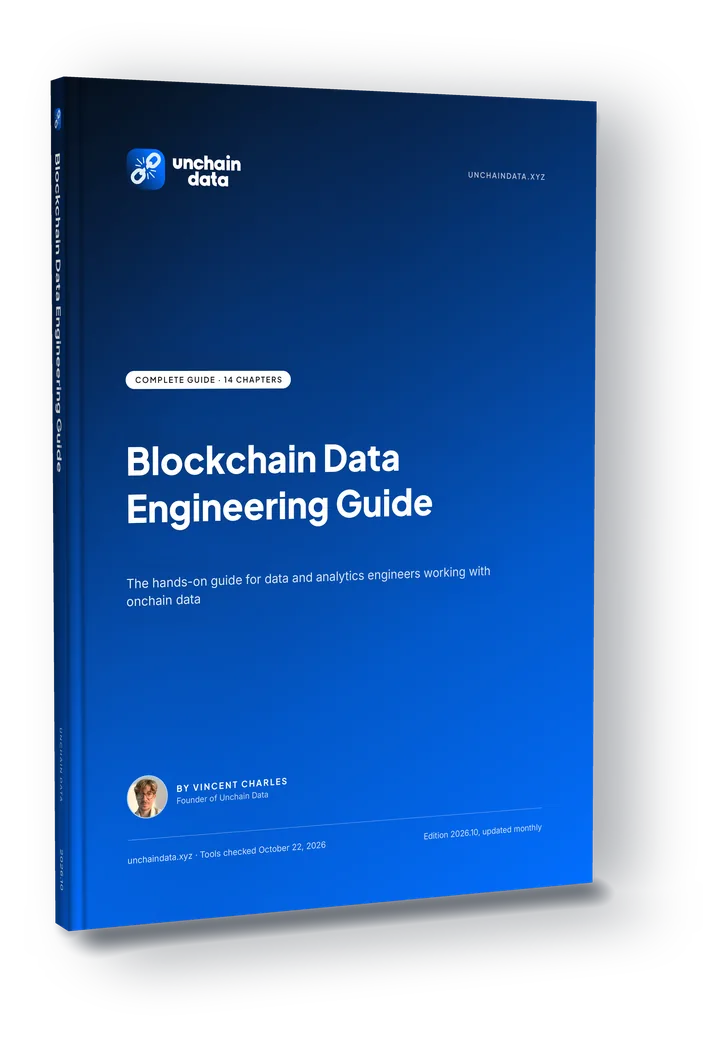
2026 guideUpdated monthly
Blockchain Data Engineering Guide
Become a $196K+ blockchain data engineer
 By Vincent Charles, ex-Binance and Morpho

 Founder of Unchain Data
- 140 pages
- 23 hands-on labs
- 3 portfolio projects
- private GitHub repo
- PDF, ePub, Markdown
What we cover


Why this guide
The best value in blockchain data engineering.
A full course's worth of material at a book's price. Self-paced, no cohort dates, no weekly sessions.
Hands-on from page one.
23 hands-on labs, including 3 portfolio projects. 19 run on free tools with no account.
The 2026 stack, not just Postgres.
ClickHouse with reorg-safe tables, Kafka and Redpanda streaming, Solana indexing, Ponder, rindexer and cryo, dbt or SQLMesh, Airflow or Dagster, BigQuery and Databricks.
Built on real hiring data.
489 live crypto data roles at 160 companies, from Unchain Data's job board (Oct 20, 2026). The guide ends with a career playbook built on it.
Buy once. Every new edition I publish is included at no extra cost. No subscription.
What's inside
14 chapters and 7 appendices, 140 pages.
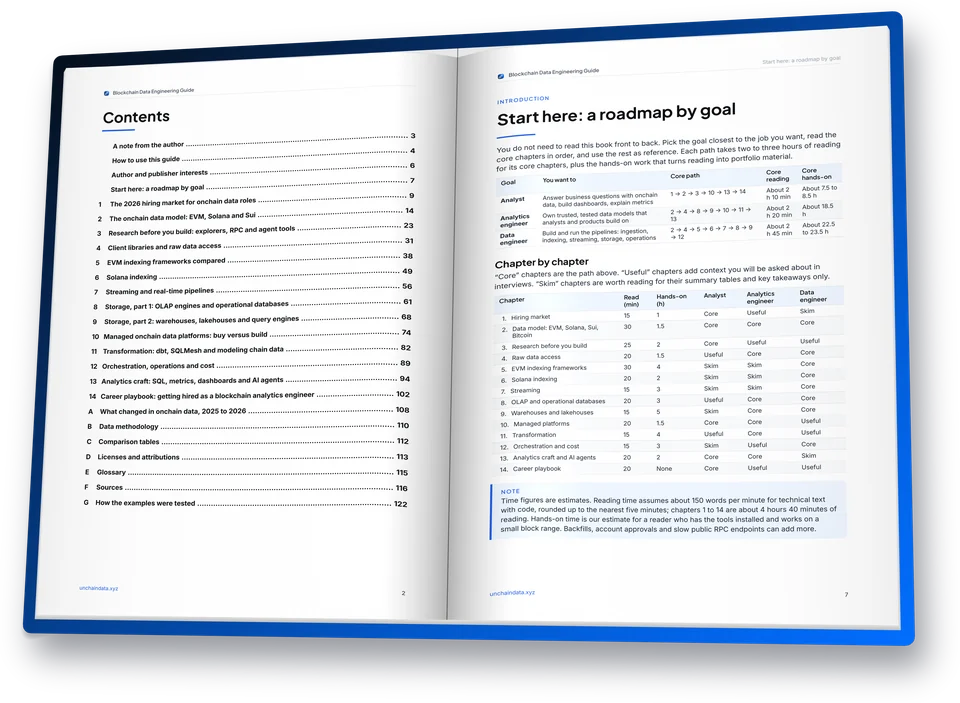
Table of contents
Chapters 1 to 14
- 1The 2026 hiring market for onchain data rolesUses Unchain Data's job board to describe 489 live crypto data roles, pay, skills and chain focus.
- 2The onchain data model: EVM, Solana and SuiRaw objects of EVM, Solana, Sui and Bitcoin, decoding bytes into columns, finality and reorgs, and 2025 to 2026 protocol changes.
- 3Research before you build: explorers, RPC and agent toolsA no-account research workflow with explorers, RPC and agent tools, then walkthroughs you can reuse on any protocol.
- 4Client libraries and raw data accessHow to pull raw chain data with client libraries, JSON-RPC, bulk extractors, data-node APIs and public datasets.
- 5EVM indexing frameworks comparedCompares Ponder, Envio, SQD, The Graph, rindexer, reth ExEx, Goldsky and Amp, then runs one indexer three ways.
- 6Solana indexingMaps the 2026 Solana data stack from Geyser and Yellowstone to frameworks, and covers Helius in depth.
- 7Streaming and real-time pipelinesBrokers, chain-native streams and four correctness rules so real-time chain pipelines stay accurate through reorgs.
- 8Storage, part 1: OLAP engines and operational databasesHow to store decoded events in ClickHouse, DuckDB or Postgres, including 256-bit amounts and reorg-safe tables.
- 9Storage, part 2: warehouses, lakehouses and query enginesCloud warehouses and lakehouses for chain data, open table formats, and how to keep large tables affordable.
- 10Managed onchain data platforms: buy versus buildMaps Dune and other managed platforms, when to buy curated data versus build, and how to check a vendor number.
- 11Transformation: dbt, SQLMesh and modeling chain datadbt and SQLMesh for chain data: layered models, incremental reorg lookbacks, tests and reconciliation against the chain.
- 12Orchestration, operations and costOrchestrators, watermarks, reconciliation and cost for chain pipelines that fail loudly and stay correct.
- 13Analytics craft: SQL, metrics, dashboards and AI agentsOnchain SQL patterns, careful metric definitions, trusted dashboards, and using AI agents without publishing their mistakes.
- 14Career playbook: getting hired as a blockchain data engineerTurns the book into a hiring plan: target roles, a skill matrix, three portfolio projects, resume and interviews.New to the role? Read how to become a crypto data engineer.
Appendices A to G
- AWhat changed in onchain data, 2025 to 2026What changed in this edition, and how the onchain data stack shifted from early 2025 to November 2026.
- BData methodologyHow the 489-role job-board figures and salary midpoints were counted, and the limits of those numbers.
- CComparison tablesAn index of the book's comparison tables, pointing back to the chapter where each is kept up to date.
- DLicenses and attributionsWhat you may reuse from the book and companion repo, third-party material, and licenses of the tools discussed.
- EGlossaryShort definitions of the onchain data and pipeline terms used throughout the book.
- FSourcesPublic documentation behind the book's main claims, with the date each source was checked.
- GHow the examples were testedHow far each companion lab was checked: syntax, a live run, or a correctness assertion against independent data.
Read a sample: Chapter 2
Every pipeline in this book starts from the same question: what does the chain actually record? This chapter covers the raw objects of EVM chains, Solana and Sui (plus a short section on Bitcoin's UTXO model), the decoding steps that turn bytes into columns, and the protocol changes of 2025 and 2026 that affect data work. If you learn one chapter well, make it this one. Most production bugs in crypto data trace back to a misunderstanding here.
EVM chains: five raw datasets
An EVM chain produces five kinds of raw data. Almost every table you will ever query is derived from them.
| Dataset | What it contains | Typical source | Use it for |
|---|---|---|---|
| Blocks | Header fields: number, hash, parent hash, timestamp, base fee, gas used | eth_getBlockByNumber | Time joins, gas analytics, reorg detection |
| Transactions | Sender, recipient, value, calldata, type, gas settings | Block bodies | Who called what, fees, function calls |
| Receipts and logs | Success flag, gas used, and the events contracts emitted | eth_getBlockReceipts, eth_getLogs | Almost all protocol analytics: transfers, swaps, deposits |
| Traces | Every internal call, contract creation and internal value transfer | debug_traceBlock*, trace_block (archive or trace-enabled nodes) | Internal ETH transfers, contract creations, call graphs |
| State | Balances, storage slots and code at a block | eth_getBalance, eth_getStorageAt, eth_call, state diff traces | Point-in-time balances, protocol parameters |
Logs are the workhorse. A log has the emitting contract address, up to four 32-byte topics and an unindexed data blob. For a normal (non-anonymous) event, topics[0] is the keccak-256 hash of the event signature and indexed parameters go into topics[1..3]. An anonymous event has no signature topic, so it can carry four indexed parameters and cannot be found by signature at all. Indexed values of dynamic types (string, bytes, arrays, structs) are stored as their keccak-256 hash, so the original value cannot be decoded from the log. Everything that is not indexed is ABI-encoded in data.
Traces fill the gaps that logs leave. Until Glamsterdam activates (see the box later in this chapter), native ETH moved by a contract emits no log, and neither does a contract deployed by a factory unless the factory chooses to emit one. Traces are expensive to fetch and store, which is why many teams only pull them for transactions they already care about.
Check your inbox for Chapter 2. The link works for 30 days.
The onchain data pipeline
What you get
- The complete guide, 140 pages
- PDF, ePub and Markdown files
- Read access to a private GitHub repository with the code from the book: 23 hands-on labs, including 3 portfolio projects
- New editions included: every new edition I publish is included at no extra cost. No subscription.
Pricing
$49One-time payment. Every new edition included. Taxes calculated at checkout.
A reader, Parth, built a full onchain indexer with the guide a day after launch.
What is blockchain data engineering?
Blockchain data engineering is building and running the pipelines that extract, decode, model, and serve onchain data so teams can use it. Onchain analytics is querying and reading that data in dashboards. Protocol and smart contract engineering designs the chain and the contracts.
Turbocharge your AI agents
The guide also comes as Markdown, so you can give it to your AI agent as context. It works with any AI agent that can read Markdown.
- Current best practices for blockchain data engineering
- Curated tools for indexing, streaming, storage and modeling
- Worked examples you and your agent can run
Blockchain data engineering course or guide?
Looking for a blockchain data engineering course? Here is how this self-paced guide compares with a typical instructor-led course, so you can pick what fits you.
| This guide | Typical instructor-led course | |
|---|---|---|
| Price | $49. One-time payment. | Varies widely, often a few hundred dollars per cohort. |
| Format | 140-page book (PDF, ePub, Markdown) plus a private GitHub repo | Live sessions, recorded lessons, or both |
| Pace | Self-paced. No start dates, no deadlines. | Fixed schedule with cohort start dates |
| Time | Read a chapter, run its lab, when it suits you | Often several hours a week for 7 to 10 weeks |
| Hands-on | 23 hands-on labs, including 3 portfolio projects. 19 run on free tools with no account. | Projects, often ending with a capstone |
| Stack | EVM and Solana indexing, ClickHouse, Kafka and Redpanda, dbt or SQLMesh, Airflow or Dagster | Depends on the syllabus |
| AI agents | Markdown files you can give to any AI agent that can read Markdown | Usually videos and slides |
| Instructors | Written guide. Questions and corrections by email to the author. | Live instructors, Q&A and office hours |
| Accountability | You set your own pace | Classmates and deadlines keep you on track |
| Best for | You know some SQL, and Python helps. You want the current stack on your own schedule. | You want live teaching, a set schedule and a certificate. |
Prefer live teaching? A course is a great choice. Want to learn on your own time and keep a reference you can reuse? The guide is built for that.

Vincent Charles
Founder of Unchain Data

 Previously Data and BI Lead at Binance and Morpho
- CEX strategy supported
- $160B+
- DeFi TVL analyzed
- $5B+
- Web3 protocols & funds advised
- 6+
I run Unchain Data and work as a fractional data lead for crypto teams.
Before that I led data and BI at Binance and at Morpho, where I built both functions from zero.
I built WizardCamp, the first web app to learn blockchain analytics with SQL. This guide is the next step, for analysts who want to go further and for engineers who want to stay current in crypto data.
Corrections and questions: vincent@unchaindata.xyz

Want to learn blockchain analytics instead?
WizardCamp teaches onchain SQL step by step, in your browser.
Real market demand
- open data engineer roles
- 88
- companies hiring data engineers
- 40
- median advertised salary, data engineer rolesBased on 37 postings with a salary range, Nov 2026.
- $196k
Source: Unchain Data's job board
Browse data engineer jobs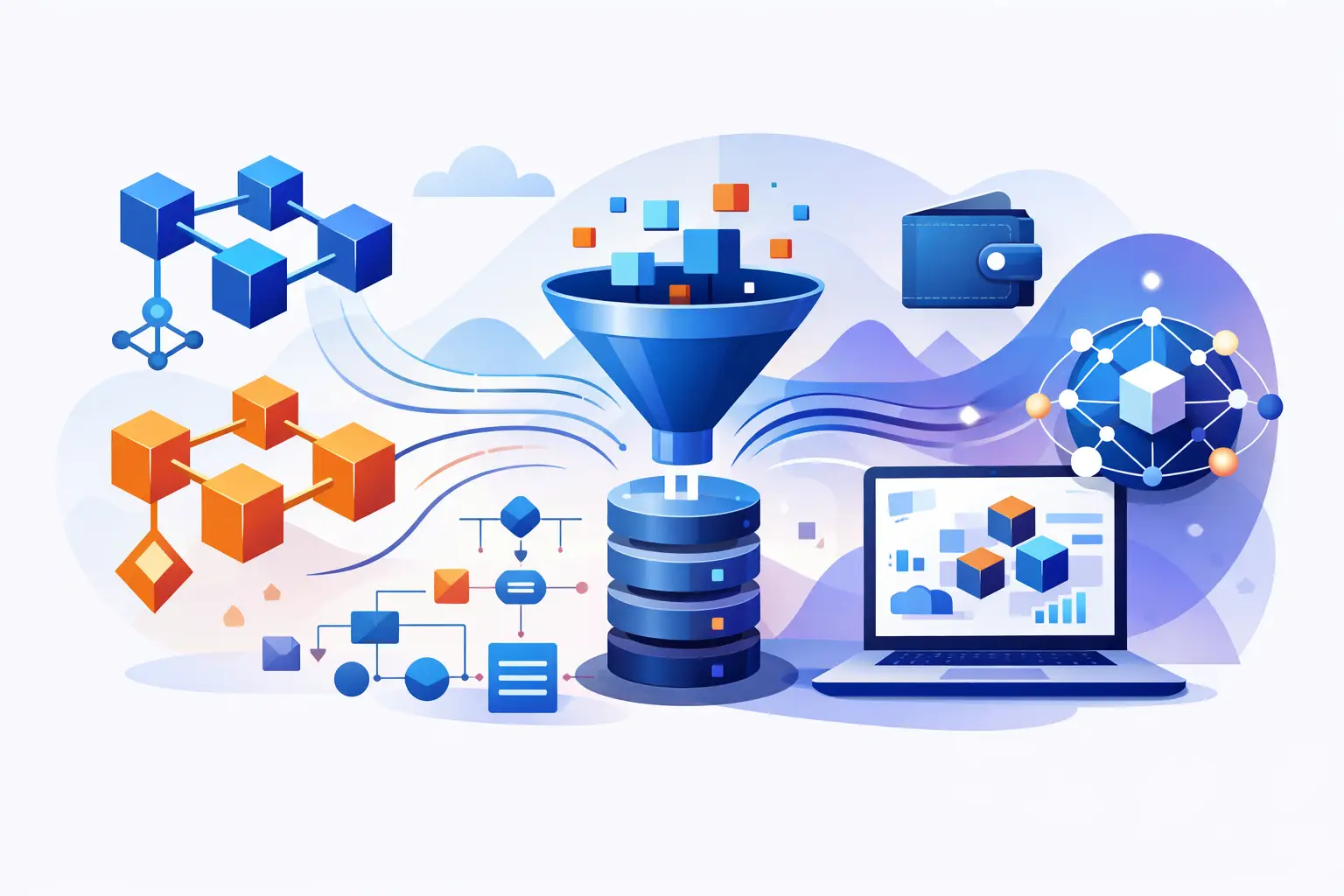

Frequently asked questions
What is blockchain data engineering?
Blockchain data engineering is building and running the pipelines that extract, decode, model, and serve onchain data so teams can use it. Onchain analytics is querying and reading that data in dashboards.
Protocol and smart contract engineering designs the chain and the contracts.
Can I buy it now?
Yes. You can buy it now. The price is $49.
How is it delivered?
Right after payment you get an email with your receipt and the downloads (PDF, ePub and Markdown). To get the code repository, reply with your GitHub username and I will send your invite within 24 hours.
How do new editions work?
The guide is dated by edition (2026.11, then the next one). When the tools change, I update the guide and the code together.
Every new edition I publish is included at no extra cost. No subscription.
Do I need a GitHub account?
Only for the repository. The downloads work without one.
Do I need to know crypto already?
No. You need basic SQL, and Python helps. Chapter 2 explains how chain data is structured.
Is this financial or investment advice?
No. It is a technical guide for data engineers and analysts. It does not cover trading or investing.
Is this a blockchain data engineering course?
Not a live course. It is a 140-page guide with a private GitHub repo of 23 hands-on labs, including 3 portfolio projects.
You learn at your own pace, with no sessions or deadlines.
How do I become a blockchain data engineer?
Start with solid SQL and some Python. Then learn how chain data is structured, how to index it, and how to store, model and orchestrate it.
The guide follows that path over 14 chapters and ends with a chapter on getting hired, built on Unchain Data's job board.
How long does it take to learn blockchain data engineering?
It depends on your background. There is no fixed timeline: each chapter comes with its lab, and the analyst, analytics engineer and data engineer paths each list their chapters and hands-on time.
Do I get a certificate?
No, the guide does not include a certificate. If a certificate matters to you, an instructor-led course is a better fit.
Is blockchain data engineering the same as onchain analytics?
No. Onchain analytics is about querying and reading chain data. Blockchain data engineering builds the pipelines, storage and models underneath.
To start with analytics, try WizardCamp, which teaches onchain SQL in your browser.
Is this for analytics engineers or data engineers?
Both. The book has three paths: analyst, analytics engineer and data engineer. Each path lists its chapters and its hands-on time.
How do I contact you?
Email vincent@unchaindata.xyz.