
Learn Onchain SQL: Inside WizardCamp, a Blockchain Analytics SQL Course

Vincent Charles
October 16, 2026 · 11 min read
Most people who want to learn onchain SQL start in the wrong place. They watch a long Dune walkthrough, copy a query into an editor, see a chart appear, and feel productive. Then a recruiter sends a live SQL round on a real transaction table, and the blank editor wins.
I have hired analysts at a centralized exchange and at DeFi protocols, and the gap is almost always the same. Candidates learned SQL on synthetic CSVs: movies, employees, a pizza shop. They have never had to reconstruct a balance from transfer logs, or explain why one swap shows up as three rows. That is the gap WizardCamp was built to close.
TL;DR:
- Blockchain analytics is a doing skill. The only real way in is reps on real data.
- WizardCamp has 163 graded exercises across an Ethereum path and a Solana path, on samples of real mainnet data, right in your browser.
- Instant grading shows exactly which rows are wrong, so you learn from every mistake.
- Start free with SQL Foundations. Each track ends in a certificate hiring managers can verify.
- Already pass a generic SQL screen? The protocol packs and Practice mode are where you get interview ready.
Why tutorials do not teach you onchain SQL
You can watch twenty hours of YouTube and still freeze at a blank SQL editor. Watching someone else write a query trains recognition, not recall. Interviews test recall, under time pressure, on data you have not seen before.
Onchain data makes this worse, because the hard part is not the syntax. One of the learners in the beta cohort put it better than I can:
You cannot vibe-query your way to a real crypto metric. The query is the easy part. The hard part is understanding crypto data itself.
An AI assistant will happily write you a GROUP BY. It will not tell you that your "active users" metric is mostly one aggregator contract, that a token has 6 decimals instead of 18, or that your join silently doubled every swap that hit two pools. Catching those things is the job, and you only learn to catch them by getting it wrong, fast, many times.
What WizardCamp is
WizardCamp is the course I wish I could have handed every junior analyst I onboarded. It has two paths that share one structure.
The Ethereum path has 85 exercises across 12 modules, plus protocol packs on Uniswap and Aave. It covers SQL Foundations, blockchain fundamentals, token analytics, NFT analytics, DeFi, traces and internal calls, MEV and order flow, cross-chain flows, L2s, real world assets, oracles, and stablecoins.
The Solana path has 78 exercises across 8 modules: chain overview, SPL tokens and the accounts model, DEXs and venues, aggregators and routing, memecoins and pump.fun, lending, staking and validators, and NFTs including compressed assets.
Every exercise works the same way:
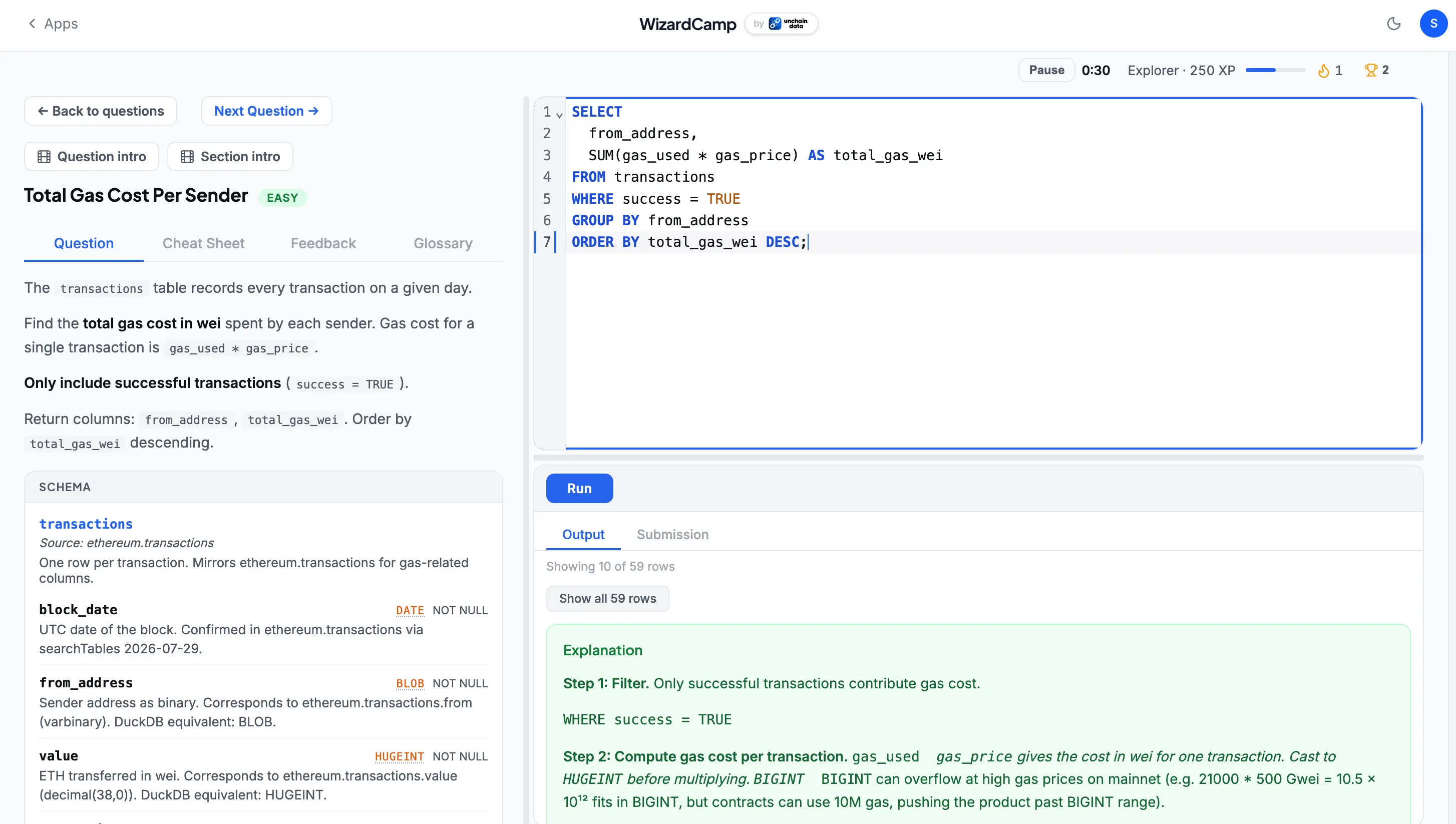
- Read the question. The concept, the schema, and a hint sit on one screen.
- Write the query against real Ethereum or Solana data. Nothing to install, on your phone or your laptop.
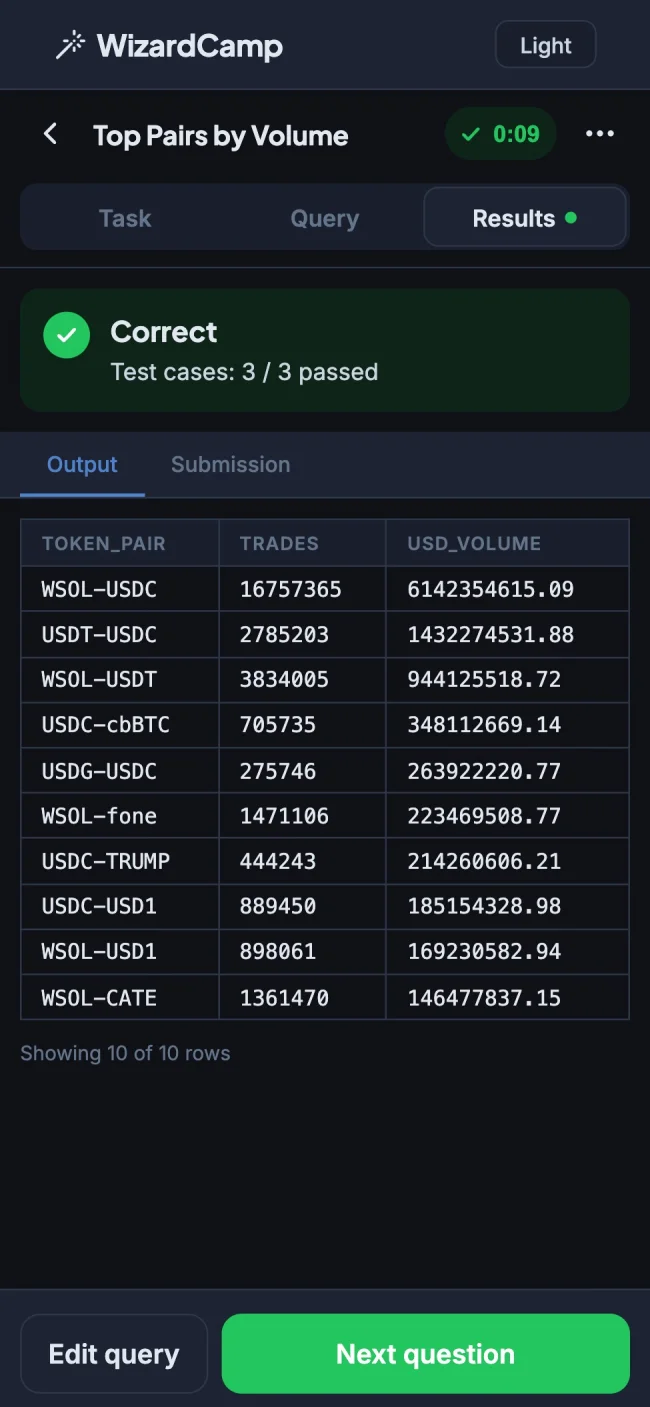
- Hit Run. Grading is instant, and it shows you which rows are wrong.
That last point matters more than it sounds. "Your answer is wrong" teaches you nothing. "Rows 4 to 9 are off" sends you straight back to the filter you forgot.
What a real exercise looks like
Here is a real question from WizardCamp's Aave Lending pack on the Ethereum path, "Aave Utilization Rate": compute the utilization rate for each token, meaning total borrows divided by total supplies, as a percentage rounded to 2 decimal places, ordered from highest to lowest. Utilization drives the interest rate curve, so it is one of the first numbers a lending team looks at.
The table is aave_events: 100 Aave V3 supply and borrow events sampled from Dune's lending.supply and lending.borrow, already scaled to human-readable token amounts. It has five columns: period, token_symbol, event_type (either supply or borrow), amount, and user_address.
A first attempt usually looks like this:
SELECT
  SUM(CASE WHEN event_type = 'borrow' THEN amount ELSE 0 END)
    / SUM(CASE WHEN event_type = 'supply' THEN amount ELSE 0 END) AS utilization
FROM aave_events
It runs and returns one clean number, about 0.0083. It fails the grader for three reasons. There is no GROUP BY token_symbol, so DAI and USDC get blended into a single ratio. The sample holds about 1.19 billion DAI of supply, which drowns out USDC entirely, so the blend describes neither market. It is a ratio rather than a percentage rounded to 2 decimals. And the denominator is unprotected: a token with zero supply would throw a division by zero instead of returning NULL, which is the edge case the grader checks.
The reference solution:
SELECT
  token_symbol,
  ROUND(
    100.0 * SUM(CASE WHEN event_type = 'borrow' THEN amount ELSE 0 END)
      / NULLIF(SUM(CASE WHEN event_type = 'supply' THEN amount ELSE 0 END), 0),
    2
  ) AS utilization_pct
FROM aave_events
GROUP BY token_symbol
ORDER BY utilization_pct DESC
It returns USDC at 141.32% and DAI at 0.31%. That first number is the real lesson. Utilization of a live market can never be above 100%, because you cannot borrow more than has been supplied. Here it can, because the exercise divides event totals inside a sample: about 6.18 million USDC borrowed against 4.37 million USDC supplied. That ratio of flows is useful for seeing which side of a market is moving. The moment you present it as the market's actual utilization, you need outstanding balances instead. The Lending module on the Solana path takes the next step: it nets deposits against withdrawals and borrows against repays, and it is explicit that even this is a change since the start of the window, not a level.
The same pattern shows up everywhere in the course. In the Uniswap pack you work from chain-by-day swap data to compute volume by chain, average swap size, each chain's market share, and day-over-day change. On Solana you learn why the accounts model means a wallet and its token accounts are not the same thing, which quietly breaks most first attempts at holder counts.
Learn builds the skill. Practice keeps it.
WizardCamp has two modes, and they do different jobs.
Learn is the guided path. It goes from zero to advanced, pairs each blockchain concept with the SQL you need to query it, and gives instant feedback on every query. If you have never written SELECT, you start with SQL Foundations, six free exercises on a small sample bookstore dataset, then move straight to real Ethereum transactions in the next module.
Practice is for drilling. Pick any topic and any difficulty, from beginner to brutal, and repeat until the pattern is automatic. This is the mode I would use in the two weeks before a live coding round. Crypto data teams still test candidates with live SQL on blockchain tables, and the people who freeze are the ones who have only ever seen tidy sample data.
Certificates you can actually verify
There are seven certificates, and SQL Foundations is free. Each one is earned by solving every question in its track, not by watching videos to the end. They are recorded server-side and live at a public link, so a hiring manager can click through and check.
- SQL Foundations (free)
- Ethereum Blockchain Foundations
- Advanced Ethereum Analyst
- Uniswap Analytics
- Aave Lending
- Solana Foundations
- Advanced Solana Analyst
A certificate will not get you hired on its own. What it does is give a recruiter a reason to believe your SQL is real before they spend an interview slot on you. Pair it with two or three serious Dune dashboards in one domain, as I described in How to Become a Crypto Data Analyst, and you look very different from the average applicant.
How WizardCamp compares to a generic SQL course
Generic SQL courses are fine for learning syntax. The difference is the data and the mental models.
| Generic SQL course | WizardCamp | |
|---|---|---|
| Data | Synthetic sample tables | Samples of real Ethereum and Solana mainnet data |
| Problems | Employees, orders, movies | Token transfers, DEX swaps, liquidations, MEV, pump.fun launches |
| Feedback | Right or wrong | Instant grading that shows which rows are wrong |
| Domain | None | Protocol mechanics, events, traces, the accounts model |
| Proof | Completion badge | Verifiable certificates per track |
Everything you learn transfers directly to the platforms you will use at work: Dune, Allium, or your company's own warehouse. The syntax and the thinking travel with you.
Who it is for
Career switchers from TradFi, fintech, or Web2. You already have the analytical instincts. What you lack is blockchain data literacy, and that is exactly what the modules teach. Centralized exchanges are the most realistic entry point for you, and they screen hard on SQL.
Junior analysts already in crypto. You can build a dashboard, but you are not sure your numbers are right. The traces, MEV, and cross-chain modules are where most people discover what they have been getting wrong.
Analysts preparing for an interview. Use Practice mode. Drill joins, window functions, CTEs, and aggregations on blockchain-native problems until you stop thinking about syntax.
Protocols and chains. If you want analysts who already know your tables before they apply, you can sponsor exercises on your data. I co-develop them with your team and keep them on the free path, with a certificate learners can post on LinkedIn.
Pricing
You can start free on either path: SQL Foundations plus the first three Ethereum or Solana exercises. Pro is $12 per month, billed annually at $144 per year, and unlocks both paths, every module, every protocol pack, Practice mode, and all seven certificates. You can cancel at any time and keep access until the end of your billing period.
For context, the cheapest professional analytics plan on the market is now around $65 per month, before you have written your first query.
Frequently Asked Questions
Do I need SQL experience to start WizardCamp?
No. The Learn path starts from zero with SQL Foundations, six free exercises covering SELECT, filtering, aggregation, joins, and CASE WHEN on a small sample bookstore dataset. The next module puts you on real Ethereum transaction data, its first three exercises are free too, and instant feedback tells you exactly what went wrong.
What blockchain data do the exercises use?
Samples of real mainnet data on both paths, once you are past SQL Foundations. On Ethereum that means transactions, token transfers, DEX swaps, lending events, bridge deposits, and MEV activity. On Solana it means SPL token transfers, DEX and aggregator trades, pump.fun launches, staking rewards, and NFT mints, sampled from the same Dune tables analysts query at work.
Should I start with the Ethereum or the Solana path?
Either works. Both start free and are graded the same way, and one Pro plan unlocks both. Pick the ecosystem you want to work in. If you are targeting EVM DeFi protocols, start with Ethereum. If you want to work on Solana DEXs, memecoins, or validators, start with Solana.
Will WizardCamp help me get a crypto data job?
It covers what crypto data teams test in technical interviews: onchain SQL, protocol mechanics, and analytical thinking. The certificates are public and verifiable, which gives you something concrete for a resume. Combine them with a small portfolio of Dune dashboards in one domain to make the strongest case.
Is it different from a Dune SQL tutorial?
Yes. A Dune tutorial shows you how someone else solved a problem. WizardCamp makes you solve it yourself, grades the result instantly, and tells you which rows are wrong. The skills transfer to Dune directly, but you build them through practice instead of watching.
Key Takeaways
- Onchain SQL is a doing skill. Reps on real data beat hours of tutorials.
- The query is the easy part. Knowing what a utilization ratio actually measures, or that one swap spans several rows, is the actual job.
- Two paths, one plan. 85 Ethereum and 78 Solana exercises, with Uniswap and Aave protocol packs.
- Instant, row-level grading shows exactly where your logic broke.
- Verifiable certificates give recruiters a reason to trust your SQL before the interview.
- Start free with SQL Foundations and the first three exercises on either path.
- Founder of Unchain Data
- Former data lead at Morpho Labs and Binance
- Builds Dune dashboards and data pipelines across Ethereum, Solana and Sui
- Advises VC funds and DeFi protocols on data strategy
- Featured on BBC for blockchain data research
Ready to practice what you just read?
WizardCamp has interactive SQL exercises on real blockchain data. Write queries, get instant feedback, earn certificates.
Explore WizardCamp