
When to Hire a Fractional Head of Data

Vincent Charles
July 14, 2026 · 12 min read

TL;DR:
- A fractional head of data is senior ownership, not a part-time analyst. It sets KPI definitions, decision frameworks, and the data roadmap.
- The signal to hire one is not "we need dashboards." It is "our numbers look right and we still cannot make a decision."
- Exchanges run structured OKR reporting. Most protocols do not. That gap is the single biggest structural difference in Web3 data leadership.
- Typical shape: 1 to 3 days a week, 2 months minimum. Less than that and you are buying opinions, not outcomes.
Most Web3 teams do not fail because they lack dashboards. They fail because nobody owns the data decisions behind product, growth, reporting, and investor communication. That is where a fractional head of data becomes useful, not as a part-time analyst, but as senior leadership that turns scattered metrics into a working operating system.
For crypto companies, the gap shows up early. One team has Dune dashboards but no source of truth for growth. Another has product events in Mixpanel, wallet activity in a warehouse, and no clean way to connect the two. A third is reporting numbers to investors that change every month because definitions were never fixed. Hiring a full-time head of data may be premature. Doing nothing is usually expensive. The middle ground is often the right move.
What a fractional head of data actually does
A fractional head of data is a senior operator who owns data strategy, decision frameworks, and execution oversight on a part-time or fixed-scope basis. The role is not just about analysis. It is about setting direction, prioritizing what matters, and making sure the team can trust the numbers they use to run the business.
In practice that means defining KPI frameworks, deciding what should be tracked, aligning product and growth metrics, improving data quality, and building a roadmap for analytics infrastructure. In Web3 it usually also means handling onchain reporting logic, wallet and user attribution, token and protocol metrics, ecosystem reporting, and board dashboards that hold up under scrutiny.
The role sits above individual dashboards and below executive strategy. It translates business goals into measurement systems, then makes sure those systems are realistic for the stage of the company. A good fractional head of data can also manage vendors, guide internal analysts and engineers, and prevent expensive architecture mistakes before they become permanent.
The number that looked like success and was not
Here is the clearest example I have of why this role exists.
Morpho launched a migration feature to move liquidity out of Aave and Compound. Onchain data showed $38M migrated. On first sight, that reads as a win. The feature shipped, the money moved, ship it to the investor update.
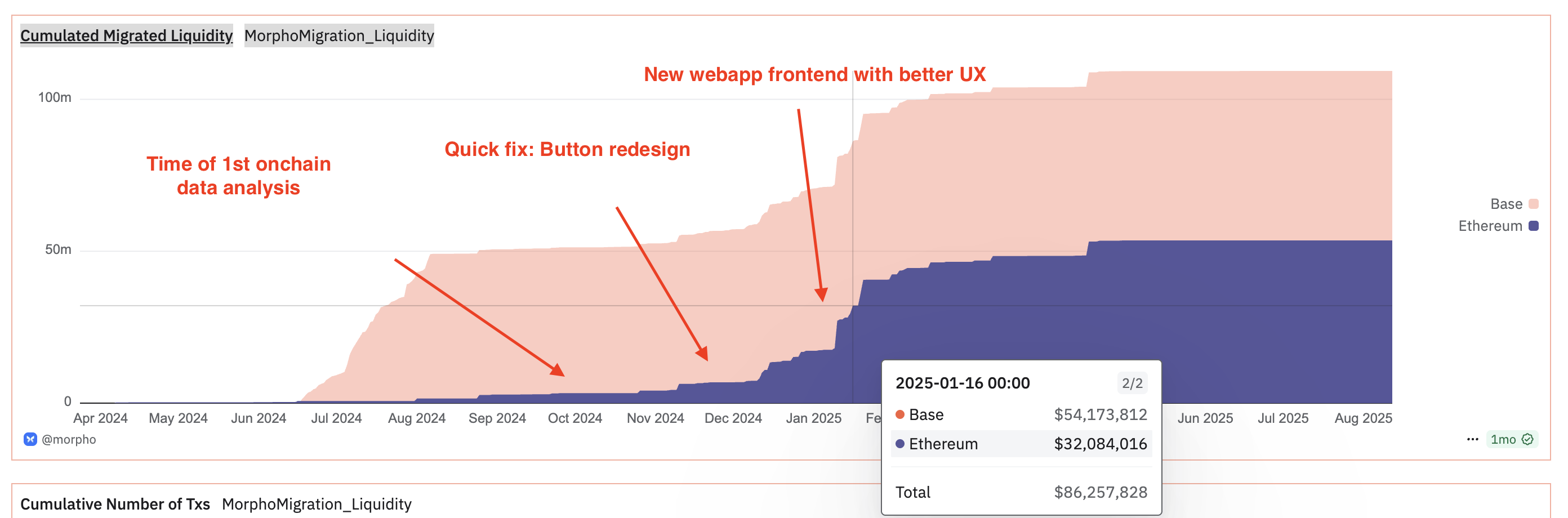
I did not believe it. Ethereum was lagging badly behind Base on both liquidity and transaction count, and there was no product reason for that gap. The chains had the same feature, the same users, the same incentive. So the asymmetry had to be coming from somewhere the onchain data could not see.
My hypothesis was the frontend. I suspected the migration CTA was a dark button on a dark background and people simply were not seeing it. But a hypothesis is a gut feeling, and you do not get an engineering team to redesign a page on a gut feeling. So I instrumented the funnel and measured it. The data confirmed it: the button had near-zero engagement. The $38M was coming from a small number of Ethereum transactions from users who found the button anyway.
That triggered a button color fix, then a full redesign, then targeted comms. Ethereum migrations grew 433%. Total migrated liquidity crossed $86M.
The lesson is not "check your button colors." The lesson is that the breakthrough came from combining onchain data with frontend analytics, and neither of those alone would have found it. Onchain said success. Frontend said nobody clicked. You need somebody senior enough to sit across both and notice the contradiction, and stubborn enough to instrument it instead of arguing about it. Full write-up in the Morpho migration case study.
The structural difference between an exchange and a protocol
I have run data at both the largest crypto exchange and at leading protocols like Morpho and Orca, and the gap that matters is not volume. It is reporting discipline.
At Binance, and at large companies generally, leadership is structured. Objectives are set, they cascade, and reporting is built to serve them. You know what the number is for, who owns it, and what decision it feeds. That structure is not glamorous but it is what turns a data team into a function instead of a request queue.
The leading DeFi protocols have picked this up. The vast majority have not. That is the real structural difference in Web3 data leadership, and it is why so many crypto teams end up with excellent dashboards nobody uses. The dashboards are not the problem. The absence of an objective they answer to is the problem.
This is the first thing a fractional lead usually fixes, because everything downstream depends on it. We wrote about how this adapts to onchain reality in Web3 OKRs: what they are and why protocols need them, and it is the basis of our Web3 OKR strategy work.
Why Web3 teams need one earlier than they think
In SaaS, the data stack is usually messy but familiar. In Web3, the mess is structural. You are dealing with smart contract events, wallet-level behavior, offchain product analytics, fragmented identity, token incentives, and data from multiple chains or vendors. The reporting problem is not just technical. It is definitional.
That is why many crypto teams hit a wall with data earlier than they expect. The first version of analytics usually gets built by whoever was available: growth, product, an engineer, sometimes the founder. That works until the business needs consistent answers to harder questions. Which wallets are actually retained users? Which campaigns drive funded accounts instead of empty sign-ups? How do you separate protocol activity from inorganic incentive farming? Which metrics belong in the investor update, and which ones are noise?
A strong operator answers those without overengineering the stack. That is the real value. Senior judgment lands before the company commits to the wrong warehouse model, the wrong KPI set, or a reporting layer nobody trusts.
The signs you should hire one
The clearest sign is when your team keeps debating numbers instead of making decisions. If growth, product, finance, and leadership all have a different version of active users, transaction volume, conversion, or revenue attribution, you do not have a dashboard problem. You have an ownership problem.
The second sign is a number that looks like success and cannot be interrogated. If nobody on the team can tell you what is underneath a headline metric, you are one investor question away from an uncomfortable meeting. That was exactly the $38M situation above.
The third is analytics stuck in reactive mode. Someone asks for a dashboard. Someone else asks for a pull. Then an investor asks for a board pack. Nothing connects and nothing compounds. A fractional lead builds a system so reporting becomes repeatable instead of custom work every week.
The fourth is when your internal team has strong execution talent but no strategic direction. Plenty of Web3 companies have capable analysts and engineers who can build. What they lack is senior guidance on priorities, architecture, metric design, and stakeholder management. That is a far cheaper problem to solve than replacing the function.
The role also fits teams heading into a fundraise, a token launch, a new chain, or a more mature go-to-market. Those are the moments when weak measurement gets exposed fast.
What day one actually looks like
I do not open a dashboard on day one. I run an audit first.
The goal is to find the gaps before touching anything: where metric definitions disagree, where the tool stack has holes or redundancy, where the numbers being reported do not connect to a business objective anyone can name. The output is a prioritized roadmap with metrics aligned to what the business is actually trying to do.
Then there is a fork. Either I implement the roadmap, or the internal team does and I oversee it. Both are fine. What is not fine is skipping the audit and going straight to building, because you end up instrumenting the wrong things faster.
That is the shape of our Web3 data strategy audit: $2,500, delivered in one week, and it is deliberately a standalone deliverable so a team can take the roadmap and run it themselves if they want to.
What to expect from a strong operator
A good fractional head of data should get to clarity fast. Within the first few weeks they should be able to name your metric inconsistencies, the weak points in your data flow, your reporting risks, and the obvious places where the business is measuring activity instead of outcomes.
They should be comfortable at two levels at once. The strategic level covers KPI design, stakeholder alignment, and roadmap decisions. The technical level covers event quality, warehouse logic, source reliability, onchain pipeline design, and whether your dashboards reflect business reality or just whatever was easiest to query.
In Web3, domain knowledge matters more than teams assume. A generic analytics consultant understands funnels and dashboards but will still miss the difference between wallets and users, between protocol activity and user intent, between an incentive-driven spike and genuine retention. Those distinctions are where the false signals live.
How to evaluate whether someone is the right fit
Start with decision quality, not tool familiarity. Tools are easy to overrate. You want someone who can explain how they would define success for your business model, what they would measure first, and which questions should stay unanswered until the foundations are better.
Ask how they handle trade-offs. Should you prioritize perfect wallet identity resolution now, or accept partial attribution and move faster on executive reporting? Should the protocol optimize around active wallets, retained wallets, or economically meaningful wallets? Strong candidates will not give you a one-size-fits-all answer. They will tell you what depends on stage, incentives, and business model.
Then look for evidence they can move from strategy to execution. Plenty of senior people can talk about data maturity. Fewer can turn that into tracking plans, warehouse decisions, dashboard logic, team workflows, and a realistic 90-day plan.
What the engagement actually looks like
Numbers, because vague answers here waste everyone's time.
I typically work 1 to 3 days a week, with a 2-month minimum engagement. The minimum is not a sales tactic. Below two months you get opinions instead of outcomes: enough time to diagnose, not enough to fix anything or to see whether the fix held.
The model works when the mandate is concrete. Establish KPIs, audit the stack, improve attribution, build a board-ready reporting layer, coach an internal analyst. Those are outcomes you can point at in month three.
It fails when the business expects one person to be strategist, analyst, engineer, dashboard builder, and 24/7 support desk. Senior leadership can guide execution. It cannot substitute for a team indefinitely. The right setup is a fractional lead paired with internal contributors or specialized implementation support.
Fractional versus full-time is not just a budget question
Founders usually frame this as cost control. That is part of it, not the main issue. The better question is whether you need permanent executive bandwidth right now, or targeted senior intervention to set the function up correctly.
A full-time hire makes sense when data has become a core organizational function: multiple reports, ongoing executive visibility, daily cross-functional complexity. A fractional model makes sense when the business still needs foundational work, sharper measurement, and senior oversight before locking in a long-term org design.
Hire too early and you overpay for a role that spends half its time on low-leverage work. Hire too late and bad definitions spread across product, growth, and investor comms, which is expensive to unwind. The right timing is when data problems start slowing strategic decisions, not when the team has reached full chaos.
The best fractional head of data does not just clean up metrics. They create leverage. They give the company a clearer way to decide what matters, what to build next, and which numbers are worth defending. For a Web3 team trying to grow without guessing, that is the difference between more data and better judgment.
If that is where you are, this is what we do: fractional head of data for Web3 teams.
Key Takeaways
- A fractional head of data is senior ownership of data decisions, not extra analyst capacity.
- The trigger to hire is decision paralysis, not dashboard absence. If four teams have four definitions of active users, that is an ownership problem.
- Onchain data alone lies by omission. The Morpho $38M migration looked like success until frontend instrumentation showed the CTA was invisible. The fix drove a 433% increase in Ethereum migrations and pushed total migrated liquidity past $86M.
- Structured OKR reporting is standard at exchanges and rare at protocols. Closing that gap is usually the first thing worth fixing.
- Start with an audit, not a dashboard. Find the definitional gaps before you instrument anything.
- Expect 1 to 3 days a week and a 2-month minimum. Shorter engagements buy diagnosis without a fix.
- Founder of Unchain Data
- Former data lead at Morpho Labs and Binance
- Builds Dune dashboards and data pipelines across Ethereum, Solana and Sui
- Advises VC funds and DeFi protocols on data strategy
- Featured on BBC for blockchain data research
Ready to practice what you just read?
WizardCamp has interactive SQL exercises on real blockchain data. Write queries, get instant feedback, earn certificates.
Explore WizardCamp