
Web3 OKRs: What They Are and Why Protocols Need Them

Vincent Charles
June 15, 2026 · 8 min read

TL;DR:
- Most protocols measure what is easy to count, token price, TVL, transaction volume, and then can't explain whether any of it reflects real growth.
- OKRs fix that by connecting strategy to a small set of outcomes the whole team agrees on, instead of a dashboard full of vanity numbers.
- Web3 needs an adapted version: onchain plus offchain data, market-responsive cycles, and tiered transparency for a public-facing org.
- The framework's value isn't the acronym. It's that every metric in the board deck traces back to a goal, with an owner.
I have run goal-setting frameworks at both the largest exchange and at DeFi protocols, and the same problem shows up almost everywhere in crypto. Teams have no shortage of data. What they lack is agreement on which numbers actually represent the business, and a structure that ties those numbers to what the company is trying to do. OKRs, adapted properly for onchain reality, are the cleanest way I have seen to close that gap.
This is a conceptual piece: what Web3-native OKRs are, why the usual token-and-TVL dashboard fails as a strategy tool, and what an adapted framework looks like. It is not a step-by-step implementation manual. The goal is to make the concept clear enough that a founder can decide whether it is worth the effort, and in most cases it is.
What OKRs are, quickly
OKRs stand for Objectives and Key Results. The framework goes back to Intel in the 1970s and is most associated with how Google scaled. An Objective is a qualitative goal, what you want to achieve. Key Results are the few measurable outcomes that tell you whether you got there.
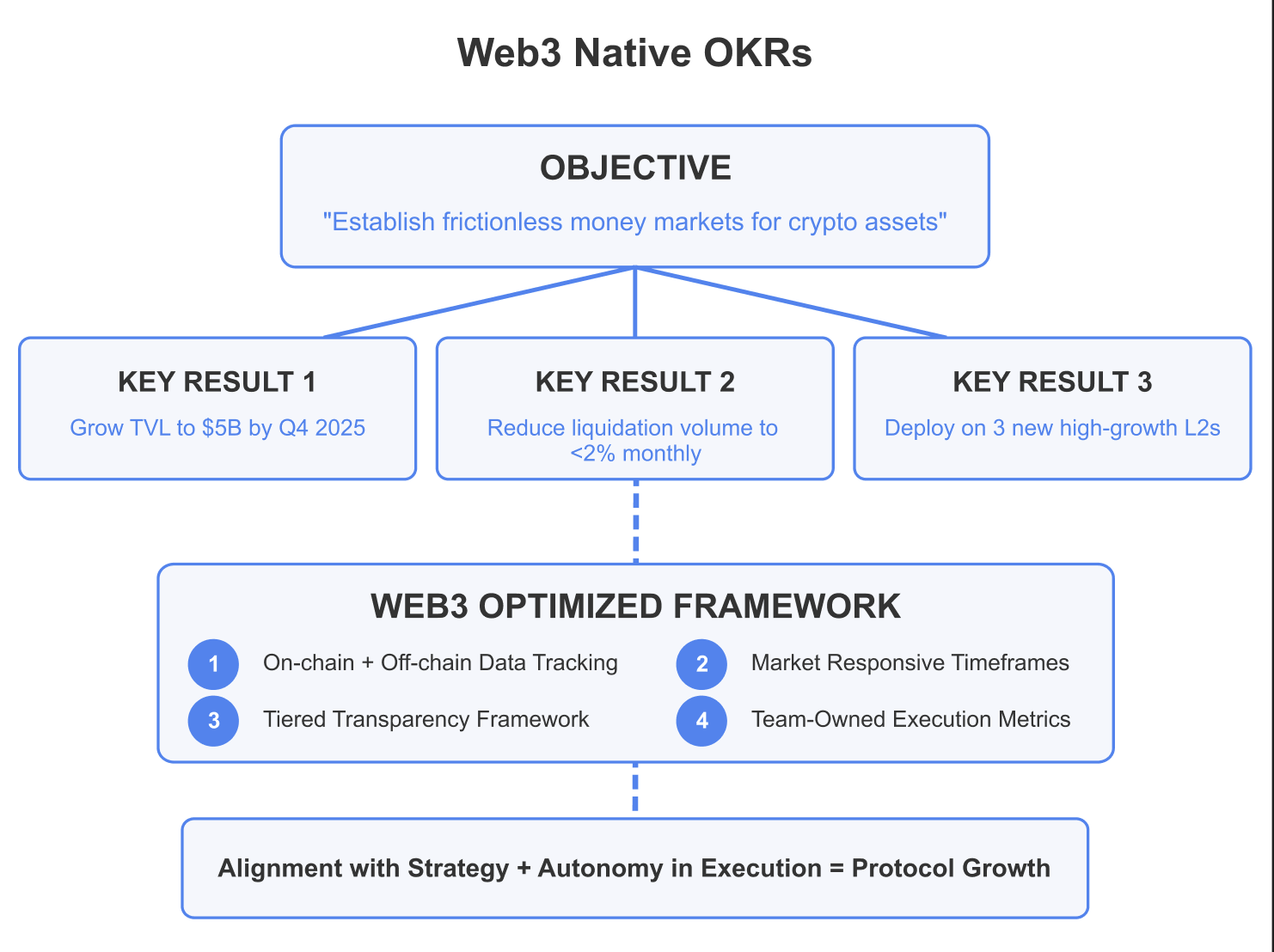
The structure is deliberately simple. One clear objective, three to five key results that measure progress, and nothing else cluttering the view. The discipline isn't in the format. It's in forcing a team to decide what actually matters this quarter and to express success as an outcome rather than an activity. "Ship the new vault interface" is an activity. "Increase retained depositors by X" is an outcome. The first you can do and still fail. The second is the thing you actually wanted.
This isn't a crypto invention, and that's part of why it works. It is a proven way to create alignment (everyone pulling in the same direction) and autonomy (teams decide how to hit the goal, not just what to do). The question is what changes when you apply it to a protocol instead of a SaaS company.
Why the usual crypto dashboard fails as strategy
Walk into most protocols and the reporting looks like this: token price, TVL, transaction count, wallet growth, social mentions. All easy to pull, all easy to circulate, and almost none of it answers whether the business is healthy.
The problem is that these are mostly lagging or distorted indicators. TVL rises when token prices rise, which tells you nothing about whether the product improved. Wallet counts inflate with airdrop farming and low-friction signups. Transaction volume can spike on a single market-making event. Treated as the scoreboard, they create a specific failure mode: teams optimize for what is easy to measure and game, not for what creates durable value. I have written before about why these vanity metrics mislead and how analysts catch it; the short version is that every headline onchain number is a claim that needs verifying before anyone builds a decision on it.
The deeper issue is disconnection. The numbers on the dashboard are not linked to the strategy, so they cannot guide it. The result is strategic drift, teams chasing several directions at once, or pivoting between whatever narrative is hot that month, with no shared definition of progress to anchor against.
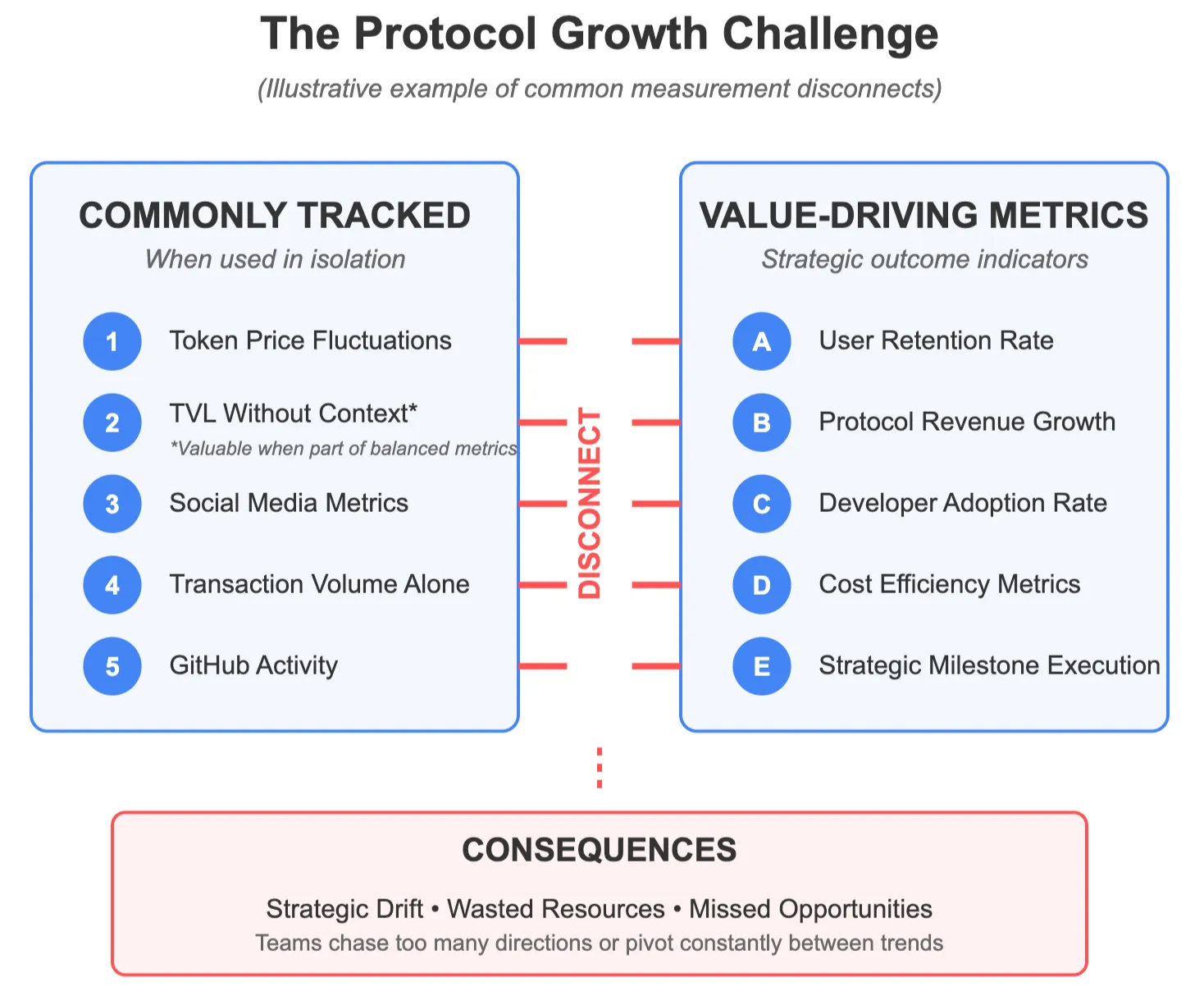
That gap, between what is commonly tracked and what actually drives value, is the entire reason a goal-setting framework earns its place. OKRs force the connection: you start from strategy, define the outcomes that represent it, and only then decide which metrics to trust as evidence.
What changes when you adapt OKRs for Web3
A protocol is not a SaaS company, and importing the framework unchanged misses the things that make crypto different. Four adaptations matter most.
Onchain plus offchain data. Most of the meaningful signal lives in two places that rarely talk to each other: what happens on the chain (deposits, swaps, liquidations, governance) and what happens in the product (the funnel, activation, retention by cohort). A key result measured only onchain misses why users behave the way they do. One measured only in product analytics misses whether the capital is real. The adapted framework assumes both, and treats reconciling them as part of the work, not an afterthought.
Market-responsive cycles. A bear market can wreck a growth target through no fault of the team. So Web3 OKRs split into two tiers. Committed goals, the ones tied to security, core retention, and infrastructure, hold regardless of market conditions. Stretch goals, the ambitious growth targets, are allowed to flex when the market shifts dramatically. This is the standard committed-versus-stretch distinction, but in crypto the volatility makes it essential rather than optional. You decide in advance what holds and what bends, so a downturn triggers a planned recalibration instead of a panic.
Tiered transparency. A protocol is partly a public entity. Some metrics belong on a community dashboard (TVL, security audits, governance participation). Some are for investors and partners (anonymized growth, roadmap progress). Some are strictly internal (exact acquisition costs, treasury strategy, competitive positioning). A Web3 OKR framework has to decide, for each metric, who sees it, instead of pretending everything is either public or secret.
Outcome ownership over output theater. This one isn't unique to crypto, but crypto violates it constantly. Every key result needs one accountable owner, even when several teams contribute. Shared ownership becomes no ownership, and a metric without an owner turns into a standing debate. The framework is what assigns the name next to the number.
None of this requires heavy tooling to start. A small set of company-level objectives, a couple of team-level layers beneath them, owners, and a review cadence is enough. The sophistication comes later, if the business needs it.
This is not just a Web2 corporate import
The most common objection I hear is that OKRs are a corporate tool that doesn't fit a decentralized, fast-moving crypto team. I think it's backwards. A distributed, autonomous organization, which is what most protocols are, needs alignment more than a centralized company does, precisely because there is no org chart forcing it. OKRs give you shared direction while leaving teams free to decide how they hit it, which fits the self-managing ethos rather than fighting it.
It is also not theoretical in crypto. Coinbase, by its own account, runs rigorous quarterly OKRs and credits them for keeping focus during hypergrowth. And the model adapts to decentralized governance: Arbitrum DAO, for instance, passed a Strategic Objective Setting proposal that lets the community adjust objectives through governance. The framework travels; what changes is the adaptation, not the core.
Small teams are not too early for this, either. If anything they benefit most, because clarity on the few things that matter is more valuable when you have the least slack to waste.
What good looks like
A working OKR framework is unglamorous in the best way. People know what the numbers mean. There is one source of truth. Weekly reviews are about movement and what to do about it, not arguments over whose definition of "active user" is correct.
That clarity is the actual product. Founders make cleaner trade-offs because the priorities are explicit. Growth understands which channels produce durable users, not just signups. Product prioritizes against behavior rather than the loudest opinion. And when leadership walks into a board meeting, every metric in the deck traces back to a strategic objective and a definition the whole team already agreed on. That is the difference between a dashboard you inspect and a system you operate from.
To make this concrete, I have built complete OKR frameworks for three protocols using only public onchain data: a DeFi lending protocol, a ZK-infrastructure network, and a SocialFi protocol, each mapping objectives, committed and stretch targets, tiered transparency, and primary KPIs onto their real public position. You can see all three worked examples here, which show what the framework looks like once it is filled in for an actual protocol.
For now, the takeaway is simpler. If your protocol is measuring everything and deciding nothing, the problem is not your dashboard. It is the missing layer between strategy and metrics. That layer is what OKRs, adapted for onchain reality, are for. If you want help building it, that is the work I do as a fractional data lead, and you can see how I approach Web3 OKRs specifically here.
Key Takeaways
- Token price, TVL, and transaction volume are diagnostics, not strategy. On their own they are lagging or gameable, and treating them as the scoreboard drives strategic drift.
- OKRs connect strategy to a small set of agreed outcomes with owners, replacing a cluttered dashboard with a few numbers that actually guide decisions.
- The Web3-native adaptation matters: onchain plus offchain data, committed-versus-stretch goals that flex with the market, and tiered transparency for a public-facing org.
- A distributed protocol needs alignment more than a centralized company, not less. OKRs give direction while leaving teams autonomy on execution.
- The point is never more metrics. It is the few that make strategy executable.
- Founder of Unchain Data
- Former data lead at Morpho Labs and Binance
- Builds Dune dashboards and data pipelines across Ethereum, Solana and Sui
- Advises VC funds and DeFi protocols on data strategy
- Featured on BBC for blockchain data research
Ready to practice what you just read?
WizardCamp has interactive SQL exercises on real blockchain data. Write queries, get instant feedback, earn certificates.
Explore WizardCamp